
There’s a particular kind of quiet that settles over a household on Friday afternoon. Somewhere between the ironed clothes laid out for the masjid and the smell of a slightly better lunch than usual, something shifts. For most Muslims, this isn’t just another day of the week it carries its own rhythm, its own etiquette, and its own sense of anticipation. Phones start buzzing a little earlier than usual too, filled with “Jumma Mubarak” messages from family group chats, old friends, and coworkers who remember what day it is even if the rest of the week blurred together.
That’s why, week after week, so many people search for the right words to mark it: a dua that feels sincere rather than copy-pasted, a message worth sending to a parent, a few lines of Arabic that capture what’s hard to say in English. Some people are looking for something to recite quietly after Jummah prayer. Others just want a thoughtful line to send an elderly relative who lives too far away to visit.
This article brings together a wide collection of Jumma Mubarak duas for blessings, rizq, forgiveness, family, and general Friday peace along with the context behind why this day holds such weight in Islam, when duas are most likely to be accepted, and how to use these words in a way that feels personal rather than borrowed.
Also Read This: 200+ Birthday Prayers, Wishes & Blessings for Your Son: Heartfelt Messages
Why Friday (Jummah) Is Important in Islam?
Friday, known as Yawm al-Jummah, holds a status in Islam that no other day of the week shares. It’s often described as the “master of days” (sayyid al-ayyam) in Islamic tradition, largely because of what is believed to have happened on this day and what continues to happen every single week for practicing Muslims.
A few reasons Friday stands apart from the rest of the week:
- It is the day Muslim men are obligated to attend the congregational Jummah prayer, which replaces the regular Dhuhr prayer entirely rather than simply adding to it.
- Islamic tradition holds that Adam (AS) was created on a Friday, and that several other significant events in human history are tied to this day as well.
- Surah Al-Kahf is recommended reading on Fridays, a practice widely mentioned in hadith literature and followed by Muslims around the world.
- There is a specific hour on Friday during which dua is considered more likely to be accepted something covered in more depth further down this article.
- Sending durood (salutations) upon Prophet Muhammad (peace be upon him) is especially encouraged on this day, more so than on any other.
None of this means other days of the week hold lesser value in Islam every day carries its own acts of worship and reward. But Friday functions almost like a spiritual checkpoint in the week, a built-in pause button. It’s a reminder to slow down, reconnect with family, and ask for the things that actually matter instead of getting swept along by routine.
There’s also a communal dimension worth mentioning. Jummah prayer is one of the few times in the week when an entire neighborhood of Muslims physically gathers in one place. That shared presence shoulder to shoulder, listening to the same khutbah carries a kind of collective energy that private worship simply doesn’t replicate.
Beautiful Dua Jumma Mubarak

A Jumma Mubarak dua doesn’t need to be long or complicated to be meaningful. Many of the most beautiful ones are short phrases pulled directly from the Quran or taught by the Prophet (peace be upon him), repeated with sincerity rather than recited out of habit. What separates a “beautiful” dua from a merely correct one is usually the intention behind it the pause before speaking, not the vocabulary used.
Here’s one gentle example that captures the spirit of the day well:
اللّهُمَّ اجْعَلْ هٰذَا الْجُمُعَةَ خَيْرَ يَوْمٍ مَرَّ عَلَيَّ، وَاغْفِرْ لِي وَلِوَالِدَيَّ وَلِلْمُؤْمِنِينَ وَالْمُؤْمِنَاتِ Allahumma-j’al hadha al-jumu’ata khayra yawmin marra ‘alayya, waghfir li wa liwalidayya wa lil-mu’minina wal mu’minat. “O Allah, make this Friday the best day that has passed over me, and forgive me, my parents, and the believing men and women.”
This kind of dua works well shared as a message or spoken quietly after prayer it’s broad enough to cover forgiveness, gratitude, and family in a single breath. A second example, slightly shorter and easier to memorize:
اللّهُمَّ إِنَّ هٰذَا يَوْمُ جُمُعَةٍ فَاجْعَلْهُ لَنَا خَيْرًا وَبَرَكَةً Allahumma inna hadha yawmu jumu’atin faj’alhu lana khayran wa barakah. “O Allah, this is the day of Jummah, so make it a source of good and blessing for us.”
If you’re new to reciting Arabic duas, it helps to pick just one and repeat it consistently for a few weeks rather than switching between several. Familiarity tends to deepen the meaning over time, in a way that constantly rotating duas doesn’t.
Best Special Jumma Mubarak Duas
Below is a curated set of duas suited to different intentions some focused on blessings, others on protection, ease, or gratitude. Rather than listing everything in plain text, here’s a quick-reference table for a handful of especially popular ones, so you can pick what fits your current situation.
| Dua Focus | Arabic (Short Form) | English Meaning |
| General blessing | اللّهُمَّ بَارِكْ لَنَا فِي يَوْمِ جُمُعَتِنَا | O Allah, bless us in this Friday of ours |
| Ease and relief | اللّهُمَّ فَرِّجْ هَمَّنَا وَاكْشِفْ كَرْبَنَا | O Allah, relieve our worries and remove our distress |
| Guidance | اللّهُمَّ اهْدِنَا فِيمَنْ هَدَيْتَ | O Allah, guide us among those You have guided |
| Protection from harm | اللّهُمَّ احْفَظْنَا مِنْ كُلِّ سُوءٍ | O Allah, protect us from every harm |
| Gratitude | اللّهُمَّ لَكَ الْحَمْدُ عَلَى كُلِّ حَالٍ | O Allah, all praise is for You in every condition |
Beyond these, many people also lean on well-known Quranic duas such as Rabbana atina fid-dunya hasanatan wa fil akhirati hasanatan waqina ‘adhaban-nar (“Our Lord, give us good in this world and good in the hereafter, and protect us from the punishment of the Fire”) specifically on Friday, since it’s considered a day when supplication carries extra weight.
A practical tip worth mentioning here: it’s easy to fall into the habit of only asking for things during dua a new job, better health, more money. Fridays are a good reminder to balance requests with gratitude and reflection, rather than treating dua purely as a wish list.
Jumma Mubarak Status
If you’re looking for something short enough for a status update or a quick text, simplicity usually works better than length. A status doesn’t need theological depth it needs to be read and felt in a few seconds. A few examples:
- “Jumma Mubarak. May this Friday bring you closer to peace, patience, and purpose.”
- “Every Friday is a fresh reminder forgive, reflect, and start again. Jumma Mubarak.”
- “May your duas be heard in this blessed hour. Jumma Mubarak to you and your family.”
- “Wishing you a Friday filled with barakah, good health, and quiet contentment.”
- “Some days ask for more from us. Fridays give more back. Jumma Mubarak.”
These work well precisely because they don’t try too hard. Overly long, quote-heavy statuses tend to get skimmed rather than actually read brevity is a feature here, not a shortcut.
Dua for Forgiveness on Friday
Forgiveness holds a special place in Friday worship, partly because Islamic tradition treats this day as one of renewal a chance to wipe the slate clean and start the coming week with a lighter heart rather than carrying the previous week’s mistakes forward.
اللّهُمَّ اغْفِرْ لِي ذَنْبِي كُلَّهُ، دِقَّهُ وَجِلَّهُ، وَأَوَّلَهُ وَآخِرَهُ، وَعَلَانِيَتَهُ وَسِرَّهُ Allahumma-ghfir li dhanbi kullahu, diqqahu wa jillahu, wa awwalahu wa akhirahu, wa ‘alaniyatahu wa sirrahu. “O Allah, forgive me all my sins, the small and the great, the first and the last, the open and the hidden.”
Reciting this after Jummah prayer, or ideally during the last portion of the day, is a practice many people find genuinely grounding not because the wording is magical, but because it forces a moment of honest self-reflection that the rest of the week rarely leaves room for.
A shorter alternative, easier to say between tasks:
رَبِّ اغْفِرْ وَارْحَمْ وَأَنْتَ خَيْرُ الرَّاحِمِينَ Rabbi-ghfir warham wa anta khayru-rrahimin. “My Lord, forgive and have mercy, for You are the best of those who show mercy.”
One common misconception worth addressing: asking for forgiveness on Friday doesn’t replace the need for sincere repentance (tawbah) or making amends with people who’ve been wronged. The dua supports that process it isn’t a substitute for it.
Also Read This: 200+ Speedy Recovery Prayer Messages for Healing, Strength, Comfort & Hope
Jumma Mubarak Dua in English
Not everyone is comfortable reciting Arabic duas from memory, and that’s completely fine sincerity matters more than the specific language used. Islamic scholarship generally agrees that dua outside of formal prayer can be made in any language the person understands and feels naturally in. Here’s a simple English-language Friday dua:
“O Allah, on this blessed day of Jummah, I ask You for forgiveness for my sins, ease in my hardships, and barakah in my time, my family, and my sustenance. Guide me to what pleases You and keep me away from what displeases You.”
Here’s a second option, slightly more personal in tone:
“O Allah, thank You for bringing me to another Friday. Grant me patience where I struggle, clarity where I’m confused, and peace where there’s been conflict. Watch over the people I love, even the ones I don’t get to speak to often.”
This can be said silently, written in a card, or shared as a message to someone who might need encouragement that particular week. There’s no requirement to memorize a fixed English phrase speaking honestly, in your own words, is entirely valid.
Dua for Rizq and Barakah
Rizq sustenance, provision, and the broader blessings tied to one’s livelihood is one of the most commonly requested things in Friday duas. This isn’t limited to money; it includes health, opportunities, family, knowledge, and even time itself, which many people overlook when thinking about “provision.”
اللّهُمَّ ارْزُقْنِي رِزْقًا حَلَالًا طَيِّبًا وَاسِعًا، وَبَارِكْ لِي فِيمَا رَزَقْتَنِي Allahumma-rzuqni rizqan halalan tayyiban wasi’an, wa barik li fima razaqtani. “O Allah, grant me lawful, pure, and abundant provision, and bless me in what You have provided.”
A related dua, often recited specifically for barakah in time and daily tasks:
اللّهُمَّ بَارِكْ لِي فِي وَقْتِي وَعَمَلِي Allahumma barik li fi waqti wa ‘amali. “O Allah, bless my time and my work.”
A practical note here: many scholars emphasize that dua for rizq works alongside effort, not instead of it asking for barakah in what you already have is just as important as asking for more. It’s also worth remembering that “barakah” isn’t just about quantity; a smaller amount that stretches further, brings less stress, and is earned through honest means is often considered more blessed than a larger amount gained carelessly.
Powerful Jumma Mubarak Dua for Morning Blessings
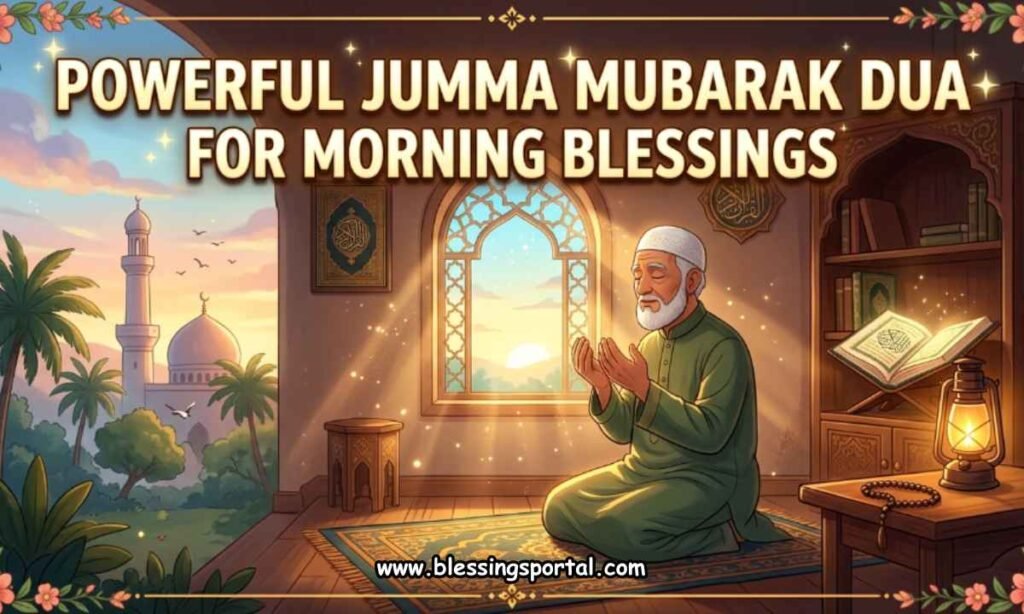
Friday mornings, especially right after Fajr, are considered a good window for setting intentions for the day ahead. The house is usually quiet, the mind is less cluttered, and there’s a sense of a full day still open ahead of you. A short but weighty dua for this time:
اللّهُمَّ اجْعَلْ أَوَّلَ هٰذَا الْيَوْمِ صَلَاحًا، وَأَوْسَطَهُ فَلَاحًا، وَآخِرَهُ نَجَاحًا Allahumma-j’al awwala hadha al-yawmi salahan, wa awsatahu falahan, wa akhirahu najahan. “O Allah, make the beginning of this day righteousness, its middle success, and its end triumph.”
It’s brief enough to say in the few quiet minutes before the household wakes up, yet it covers the entire day ahead start, middle, and end in one short line. Some people pair this with a brief personal request for the day’s specific tasks, whether that’s a job interview, a difficult conversation, or simply getting through a long to-do list with patience intact.
Beautiful Heart Touching Jumma Mubarak Quotes
Quotes tend to travel further than long duas, especially on social media, because they distill a feeling into a single line rather than requiring the reader to sit with something lengthy. A few that carry genuine weight rather than empty sentiment:
- “Fridays remind us that no matter how heavy the week was, there’s always a door open for forgiveness.”
- “The best gift you can give someone on Jummah is a sincere dua said quietly in their name.”
- “Peace doesn’t always come loudly sometimes it arrives in the stillness of a Friday afternoon.”
- “A Friday well spent in reflection is worth more than a month spent in distraction.”
- “You don’t need perfect words to reach Allah. You just need honest ones.”
Heart Touching Jumma Mubarak Quotes in English
For those who prefer sending something in plain English rather than a translated Arabic phrase, here are a few standalone lines that work well as messages or captions:
- “May this Friday soften what’s been hard and heal what’s been hurting.”
- “A Jummah spent in gratitude is worth more than a hundred spent in complaint.”
- “May your prayers today reach further than you expect.”
- “Some weeks test us. Every Friday is proof that we’re still here, still trying, still hopeful.”
- “Wishing you a Friday that gives you exactly what your heart’s been quietly asking for.”
Jumma Mubarak Dua for Parents and Loved Ones
Friday is often the day people specifically remember parents living or deceased in their duas. This one is widely recited for that purpose and is directly rooted in the Quran:
رَبِّ ارْحَمْهُمَا كَمَا رَبَّيَانِي صَغِيرًا Rabbi-rhamhuma kama rabbayani saghira. “My Lord, have mercy upon them as they cared for me when I was small.”
For parents who have passed away, many people also add a dua asking for their forgiveness and elevated status, along with charity done on their behalf, since Friday is considered a particularly good day for such acts.
For loved ones more broadly siblings, friends, spouses, extended family a simple addition works well: “Allahumma barik lahum wahfazhum” (“O Allah, bless them and protect them”). It doesn’t need to be complicated to be sincere; naming the person in your heart while saying it is often what makes the difference.
Jumma Dua for Family Protection
Family protection duas tend to focus on both physical safety and emotional wellbeing protection from harm, but also from disputes, hardship, distance, and the kind of quiet resentment that can build up between people who love each other but rarely talk things through.
رَبَّنَا هَبْ لَنَا مِنْ أَزْوَاجِنَا وَذُرِّيَّاتِنَا قُرَّةَ أَعْيُنٍ وَاجْعَلْنَا لِلْمُتَّقِينَ إِمَامًا Rabbana hab lana min azwajina wa dhurriyyatina qurrata a’yunin waj’alna lil-muttaqina imama. “Our Lord, grant us from among our spouses and offspring comfort to our eyes, and make us leaders for the righteous.”
This is a Quranic dua, found in Surah Al-Furqan, which is part of why it’s so widely used it isn’t just a nice-sounding phrase, it’s a supplication with scriptural roots that generations of Muslims have relied on.
A second one, often recited for protection from harm and evil more broadly:
أَعُوذُ بِكَلِمَاتِ اللَّهِ التَّامَّاتِ مِنْ شَرِّ مَا خَلَقَ A’udhu bikalimatillahit-tammati min sharri ma khalaq. “I seek refuge in the perfect words of Allah from the evil of what He has created.”
This particular dua is often taught to children as well, since it’s short, easy to memorize, and applicable to almost any situation involving fear or uncertainty.
Short Jumma Mubarak Duas in Arabic
Sometimes the shortest duas carry the most weight, simply because they’re easy to remember and repeat throughout the day without needing a card or a phone screen in front of you. A quick table of a few short ones worth memorizing:
| Occasion | Arabic | Transliteration |
| General Friday dua | اللّهُمَّ بَارِكْ لَنَا فِي جُمُعَتِنَا | Allahumma barik lana fi jumu’atina |
| Seeking ease | رَبِّ يَسِّرْ وَلَا تُعَسِّرْ | Rabbi yassir wa la tu’assir |
| Seeking mercy | رَبِّ ارْحَمْنِي | Rabbi-rhamni |
| Before sleeping Thursday night | اللّهُمَّ اجْعَلْ غَدِي خَيْرًا مِنْ يَوْمِي | Allahumma-j’al ghadi khayran min yawmi |
A small habit that helps with memorization: pick one short dua per month rather than trying to learn several at once. Repeating a single phrase daily for a few weeks tends to make it stick far better than cramming a list.
Jumma Mubarak in Urdu
For Urdu-speaking readers, the sentiment often carries a slightly different tone warmer, more personal, and typically shared with elders rather than peers. A common phrase used across South Asian Muslim communities:
“جمعہ مبارک ہو، اللہ تعالیٰ آپ کی تمام دعائیں قبول فرمائے اور آپ کی زندگی میں برکت عطا فرمائے۔” (“Jumma Mubarak ho, Allah Ta’ala aap ki tamam duayen qubool farmaye aur aap ki zindagi mein barkat ata farmaye.”) “Happy Friday — may Allah accept all your duas and bless your life.”
A slightly shorter version, more common in casual family messages:
“جمعہ مبارک، اللہ آپ کا دن بابرکت بنائے۔” (“Jumma Mubarak, Allah aap ka din ba-barkat banaye.”) “Jumma Mubarak, may Allah make your day blessed.”
This kind of message is commonly shared with elders or extended family, where Urdu feels more natural and heartfelt than English or formal Arabic. It’s worth noting that tone matters here the same message sent to a grandparent versus a friend often gets adjusted slightly for warmth or formality, even within the same language.
Jumma Mubarak Dua Images & Beautiful Friday Messages
Many people prefer sending a short dua alongside a simple image a mosque silhouette, calligraphy, or a soft sunset rather than plain text. If you’re creating or sourcing these for personal or website use, a few practical guidelines help:
- Keep the Arabic text large and legible; a beautiful dua is wasted if it’s unreadable in a thumbnail on someone’s phone.
- Pair Arabic with a transliteration and translation so it’s accessible to a wider, more diverse audience.
- Avoid overly busy backgrounds readability should always come before decoration.
- Credit any calligraphy or design work if it isn’t your own, and avoid using images with unclear licensing.
- Where possible, favor simple, calming color palettes deep greens, soft golds, muted blues over bright or cluttered designs, since these tend to match the reflective tone of the day.
Authentic Hadith About Friday Duas
There’s a well-known narration, found in the major hadith collections including Sahih Bukhari and Sahih Muslim, describing an hour on Friday during which a Muslim’s supplication is answered if it coincides with a moment of sincere prayer. The exact timing of this hour isn’t fixed identically in every narration scholars have discussed a few different possibilities over the centuries, which is part of why the “last hour before Maghrib” view, covered in more detail below, is so widely followed today.
Separately, there are hadiths encouraging Muslims to send abundant durood (blessings) upon the Prophet Muhammad (peace be upon him) specifically on Fridays, as this day is described as one on which such blessings are presented to him. Reading Surah Al-Kahf on Friday is also mentioned in hadith literature as a recommended practice, believed to bring light and protection until the following Friday.
There’s also guidance encouraging Muslims to take a bath (ghusl) before attending Jummah prayer, to wear clean and presentable clothing, and to arrive early rather than rushing in at the last moment all practices tied to the general emphasis on preparing well for this particular day of the week.
As with any religious guidance, readers are encouraged to consult a qualified scholar or trusted local imam for detailed rulings, since interpretations of specific narrations can vary between schools of thought, and this article is meant as a general overview rather than a substitute for scholarly advice.
Also Read This: 50+ Powerful Pornography Prayer Points With Scriptures
Best Time to Make Dua on Friday
Because the exact “hour of acceptance” isn’t universally agreed upon in every narration, most scholars point to two commonly cited windows:
- From the time the imam sits down for the khutbah until the end of the Jummah prayer.
- The final hour before Maghrib (sunset) on Friday.
Many people choose to be extra intentional during both windows, rather than picking one over the other, simply because neither view is dismissed outright in the scholarly tradition and there’s little downside to making dua sincerely at multiple points during the day.
A common mistake worth avoiding: treating this hour as some kind of guaranteed vending machine for requests. Islamic teaching generally frames dua acceptance as something that can take different forms a request granted directly, a hardship removed instead, or a reward stored for later rather than a strict transaction where every specific wish is fulfilled exactly as asked.
Jumma Mubarak Dua for Health, Peace & Happiness

Health and peace of mind are recurring themes in Friday duas, especially given how much stress people quietly carry into the weekend without saying so out loud.
اللّهُمَّ إِنِّي أَسْأَلُكَ الْعَافِيَةَ فِي الدُّنْيَا وَالْآخِرَةِ Allahumma inni as’aluka al-‘afiyata fid-dunya wal-akhirah. “O Allah, I ask You for well-being in this world and the next.”
A shorter companion dua for peace of mind, often recited alongside it:
اللّهُمَّ إِنِّي أَسْأَلُكَ قَلْبًا سَلِيمًا Allahumma inni as’aluka qalban saliman. “O Allah, I ask You for a sound heart.”
Happiness, in this context, isn’t treated as a separate request from health and peace Islamic tradition generally links inner contentment closely to spiritual wellbeing, which is part of why these three themes so often appear together in the same dua.
Friday Dua Before Maghrib (Last Hour of Friday)
The final hour before Maghrib on Friday is treated by many scholars as one of the strongest candidates for the “hour of acceptance” mentioned in hadith. Practically speaking, this means:
- Setting aside even ten quiet minutes before Maghrib specifically for dua, away from screens and conversation.
- Avoiding distractions phones, background noise, unfinished chores during that window if at all possible.
- Making dua in your own words, not only reciting memorized Arabic phrases, so the request actually reflects what’s on your mind.
- Including dua for others, not just personal requests, as this is also encouraged in Islamic teaching and tends to shift focus away from anxiety toward gratitude.
- Ending the dua with praise and gratitude, rather than only requests, which many people find changes the emotional tone of the moment entirely.
There’s no single “correct” dua for this hour sincerity and timing matter more than the exact wording chosen. Some people use this time for a long, personal conversation with Allah in their own language; others prefer repeating a handful of short, memorized phrases. Both approaches are valid, and neither is inherently more effective than the other.
Common Mistakes to Avoid When Making Jumma Dua
A few small habits can quietly take away from the experience of Friday dua, even when the intention behind them is good. It’s worth being aware of these, if only to sidestep them going forward.
- Rushing through the words without meaning them. Reciting a memorized Arabic dua at speed, purely out of habit, tends to turn a meaningful act into a mechanical one. Slowing down even for a fifteen-second dua usually makes a noticeable difference.
- Only asking, never reflecting. It’s easy to treat dua as a request list. Pausing to actually think about what you’re grateful for, or what you might need to change in yourself, rounds out the experience in a way pure asking doesn’t.
- Copy-pasting messages without reading them first. Forwarding a Jumma Mubarak message without reading it can occasionally mean sending something that doesn’t actually reflect your relationship with the recipient worth a quick glance before hitting send.
- Treating the “hour of acceptance” as the only valid time. While the last hour before Maghrib is significant, dua is valid and encouraged throughout the entire day, not confined to a single window.
- Skipping sincerity for length. A short, honest dua said with full attention tends to carry more weight than a long one recited absentmindedly. Length was never really the point.
None of these are meant to induce guilt they’re simply patterns that tend to creep in over time, especially when Friday routines become automatic rather than intentional.
Frequently Asked Questions
Is it necessary to recite duas in Arabic only?
No. While Arabic duas carry the exact wording taught in the Quran and hadith, supplicating in your own language is fully acceptable, especially for personal matters.
Can I say Jumma Mubarak dua for someone who isn’t Muslim?
Yes, sending well-wishes like “Jumma Mubarak” as a kind gesture is fine, though duas involving religious content are generally most meaningful when shared with fellow Muslims.
Do I need to be in a state of wudu to make dua?
Wudu is recommended for prayer and is generally good practice for dua, but it isn’t a strict requirement for supplicating to Allah at any moment.
What’s the difference between dua and durood?
Dua is a general supplication or request to Allah, while durood specifically refers to invoking blessings upon Prophet Muhammad (peace be upon him).
Can women make Friday dua even without attending Jummah prayer?
Yes. Jummah prayer attendance is obligatory for men, but Friday’s blessings, including the recommended hour of dua, are not limited to those attending the mosque.
Conclusion
Friday has a way of arriving with its own quiet invitation to pause, to ask sincerely, and to reconnect with the people and habits that matter most. Whether it’s a short Arabic phrase memorized years ago or a few honest lines in English said right before Maghrib, what makes a Jumma Mubarak dua meaningful isn’t its length or its source it’s the intention sitting behind it. Use the ones gathered here as a starting point, but don’t hesitate to let your own words fill in whatever they leave out. Some weeks call for a formal, memorized supplication; others just need a simple, honest conversation with Allah about whatever’s been sitting heavy on your mind. Both count. Both matter. And both are, in their own way, exactly what this day was set aside for.
Also Read This: Prayer for Job Security: Finding Strength and Peace in Uncertain Times

With 4 years of experience writing about blessings and positive living, William Parker is passionate about creating heartfelt content that inspires faith and gratitude. Their mission is to provide readers with daily blessings and uplifting words that brighten lives and nurture inner peace.