
A friend once told me she almost named her son Tristan, then paused at the last minute because she wanted to know if it had any roots in Scripture. It’s a more common hesitation than you’d think. Parents choosing a name for a child they’re raising in faith often want more than something that sounds nice they want to know what they’re actually giving their kid to carry. So if you’ve landed here wondering whether Tristan shows up in the Bible, or what it might mean in a spiritual sense, you’re asking a fair and pretty common question.
The short answer is that Tristan has no biblical origin at all. But that doesn’t mean the name is spiritually empty far from it. Once you understand where the name actually comes from, its meaning takes on a resonance that a lot of Christian parents find genuinely fitting.
Also Read This: Who Is Mazikeen? Biblical Origins, Jewish Folklore, Mythology & Lucifer Explained
Does Tristan Appear in the Bible?
No. Tristan does not appear anywhere in the Old or New Testament, in any translation, and it isn’t a transliteration of a Hebrew, Greek, or Aramaic name found in Scripture. If you’ve searched a Bible concordance and come up empty, that’s because there’s nothing to find it’s not an oversight or a rare textual variant.
That said, plenty of names people assume are biblical actually aren’t (think Wyatt, Miles, or Blake), and plenty of names people assume aren’t biblical actually are (Cyrus, for instance). Tristan simply falls into the first camp. Its absence from the Bible doesn’t diminish it; it just means its story is found elsewhere.
What Does the Name Tristan Mean?
Tristan is widely understood to mean “sorrowful” or “full of sadness.” This meaning is the reason the name carries so much emotional and spiritual weight, even without a scriptural anchor. It’s one of the few common names whose core meaning is an emotion rather than a virtue, a nature image, or a divine reference which is part of why people search for a deeper spiritual layer behind it.
Tristan Name Origin and Etymology
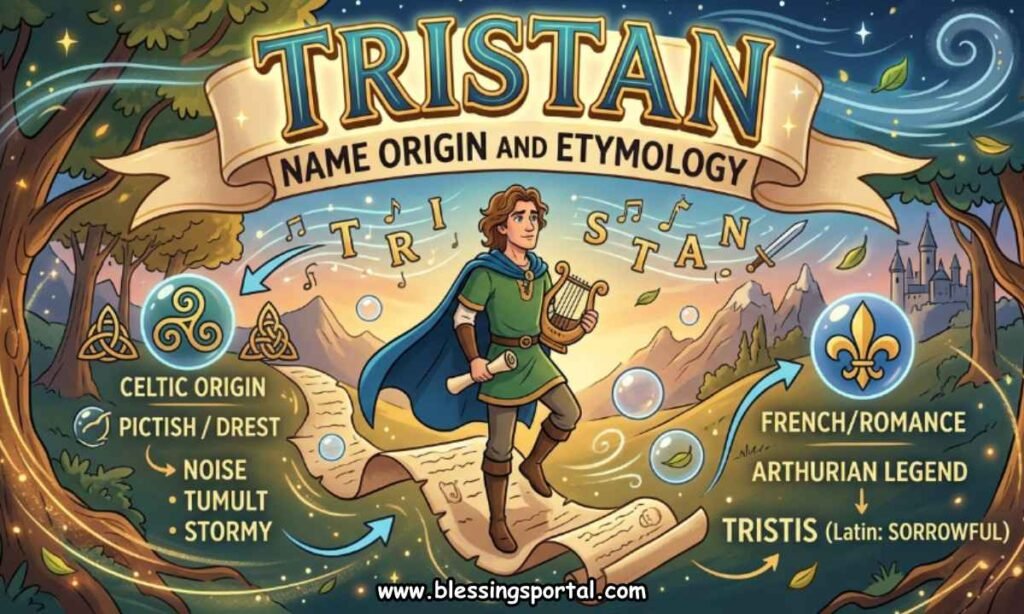
Tristan’s roots trace back to the Celtic name Drystan, found in early Welsh and Brythonic legend, most famously as the tragic hero of the medieval romance Tristan and Iseult a story of forbidden love, exile, and heartbreak that circulated across medieval Europe centuries before it was written down in the form we recognize today.
Here’s where the etymology gets interesting: many scholars believe the name’s link to “sorrow” is actually a folk etymology that developed over time, as the Celtic name blended with the Old French word triste, meaning “sad.” Whether or not that connection was linguistically accurate at the start, it stuck and it shaped both the character’s storyline and the name’s meaning as we understand it today. In the legend, Tristan’s life is genuinely marked by loss, longing, and tragedy, which only reinforced the “sorrowful” association over the centuries.
By the 19th century, the name had become firmly associated with sadness in the popular imagination, partly cemented by Richard Wagner’s opera Tristan und Isolde, which leaned heavily into themes of yearning and tragic love.
Is Tristan a Biblical Name?
No, Tristan is not a biblical name in the traditional sense it doesn’t come from Hebrew or Greek Scripture, and it has no direct etymological connection to any biblical figure. It belongs to the category of names with Arthurian and Celtic literary origins, alongside names like Lancelot, Gawain, or Percival.
That distinction matters for parents doing their research, because it’s easy to find name-meaning sites online that stretch the truth to make a name sound more “Christian” than it is. Tristan’s meaning of sorrow is real and well-documented; its biblical pedigree is not. The honest answer is more useful than a manufactured one, especially if you’re choosing a name with intention.
Spiritual Meaning of Tristan in a Biblical Context
Even without appearing in Scripture, Tristan’s core meaning sorrow maps onto one of the Bible’s most consistent and honest themes: that suffering is real, but it is never the final word. Scripture doesn’t shy away from sorrow; it addresses it directly, again and again, and almost always points toward what comes after it. Here’s how the name’s meaning can be read through a biblical lens.
1. Sorrow Transformed by Faith
The Bible treats sorrow as something to move through, not something to be ashamed of. Grief and lament fill entire books, including Lamentations and large portions of the Psalms, yet they’re consistently framed as steps on the way to restoration rather than dead ends. A name rooted in sorrow can be understood, in this light, as the starting point of a story rather than its conclusion.
Also Read This: William Meaning in Bible: Truth, Symbolism, and Spiritual Insights
2. Endurance Through Trials and Perseverance
Scripture repeatedly links hardship to growth in character. James 1:2-4 frames trials as something that produces steadfastness, and Romans 5:3-4 describes a similar chain running from suffering to endurance to hope. A name that begins in sorrow but points toward endurance fits neatly into that biblical pattern.
3. Pain Leading to Purpose
One of the more striking threads in the Bible is how often pain becomes the mechanism for a larger purpose rather than an obstacle to it. Joseph’s years of betrayal and imprisonment in Genesis eventually position him to save his family from famine. The pattern isn’t that suffering is good in itself it’s that it often isn’t wasted.
4. Hope and Strength Through Difficult Times
Passages like Isaiah 41:10 and Psalm 34:18 speak directly to people in distress, offering reassurance rather than explanation. The Bible doesn’t typically resolve why suffering happens; it focuses instead on the presence of comfort within it. A name associated with sorrow can, in that sense, be paired with an equally strong association with the hope that Scripture insists follows it.
5. Faith in the Midst of Suffering
Job is the Bible’s clearest case study in maintaining faith without receiving an explanation for suffering. His story doesn’t offer neat answers, which is part of what makes it durable it models faith as something that can coexist with grief rather than replace it.
Key Bible Verses That Reflect the Meaning of Tristan
If you’re drawn to Tristan for its emotional depth, these verses reflect the same territory of sorrow, endurance, and eventual hope:
- Psalm 34:18 — on God’s closeness to the brokenhearted
- Psalm 30:5 — on grief giving way to joy
- Romans 5:3-4 — on the progression from suffering to hope
- James 1:2-4 — on trials producing maturity
- Isaiah 41:10 — on strength offered in fear
- John 16:33 — on peace amid trouble
- Job 1-2 — on faith held through unexplained loss
Bible Verses About Sorrow, Strength, and Perseverance
Beyond the verses tied directly to Tristan’s meaning, the Bible returns to this theme so often that entire books are structured around it. Ecclesiastes wrestles with the meaning of hardship across an entire lifetime. Lamentations is, as the name suggests, a sustained expression of grief that still turns toward faithfulness in its third chapter (“His mercies are new every morning”). 2 Corinthians 4:8-9 describes being “hard pressed on every side, but not crushed” a phrase many people find captures the emotional core of a name like Tristan better than any single definition could.
Tristan and Biblical Figures Who Overcame Suffering
Tristan isn’t a biblical name, but its meaning finds real parallels in several figures whose stories are defined by sorrow that didn’t stay the final chapter:
- Joseph endured betrayal, slavery, and false imprisonment before becoming second-in-command of Egypt and saving his family.
- Job lost his health, wealth, and children, and still refused to curse God, eventually having his fortunes restored.
- David spent years in exile, hunted and grieving, before becoming Israel’s king and his psalms remain some of the most honest writing about sorrow in all of Scripture.
- Hannah, in 1 Samuel, wept bitterly over her childlessness before her prayer was answered with the birth of Samuel.
None of these figures are named Tristan, obviously but the emotional shape of their stories is exactly what people are often searching for when they ask about the “meaning” of a name tied to sorrow.
Also Read This: What Does Liam Mean in the Bible? Origins, Verses & Spiritual Meaning 2026
Is Tristan a Good Christian Name?
Yes, many Christian parents consider Tristan a good name, even without biblical origins. A name doesn’t need scriptural roots to carry Christian meaning; what matters more to most parents is whether the name’s story and symbolism align with values they want to pass on. Tristan’s arc sorrow that doesn’t stay sorrow forever resonates with a distinctly Christian outlook on suffering and hope.
Is Tristan a Good Name for a Christian Baby?

It can be. Some parents specifically choose names with emotional depth like Tristan because they want their child’s name to carry a story of resilience rather than just a pleasant sound. Others prefer names with direct scriptural roots and would rather choose from that pool. Neither approach is more “correct” it comes down to what matters most to your family. If you do choose Tristan, many parents pair it with a biblical middle name (James, Elijah, or Samuel, for example) to ground it more directly in Scripture.
What Does Tristan Mean Spiritually?
Spiritually, Tristan can be understood as a name that acknowledges sorrow honestly rather than avoiding it, while pointing toward the possibility of faith, endurance, and eventual hope on the other side of it. It’s less a name about permanent sadness and more one about what a person carries through sadness which is a theme the Bible returns to constantly, even if the name itself never appears in its pages.
Frequently Asked Questions
Is Tristan a name in the Bible?
No. Tristan does not appear in the Bible in any book or translation.
What does Tristan mean in the Bible?
Since Tristan isn’t a biblical name, it has no direct biblical definition its meaning of “sorrowful” comes from Celtic and Old French roots instead.
Is Tristan a Christian name?
Not by origin, but many Christian families use it because its meaning aligns with biblical themes of enduring sorrow with faith.
What is the spiritual meaning of Tristan?
It’s often read as sorrow that leads toward faith, endurance, and hope, echoing themes found throughout Scripture.
What Bible verses relate to the meaning of Tristan?
Psalm 34:18, Romans 5:3-4, and James 1:2-4 are commonly cited for their focus on sorrow, perseverance, and hope.
Is Tristan a good biblical name for a boy?
It’s not biblical by origin, but its meaning is often considered fitting for families who value a name that reflects resilience and faith through hardship.
Conclusion
Tristan won’t turn up in a Bible concordance, and there’s no reason to pretend otherwise. What it does offer is something a little rarer: a name whose meaning sorrow happens to sit right at the center of one of the Bible’s most repeated promises, that grief is never the end of the story. Whether or not that’s reason enough to use the name is a personal call, but it’s at least an honest one.
Also Read This: 250+ Damien Name Meaning in the Bible, Origin, Symbolism & Spiritual Meaning (2026)

With 4 years of experience writing about blessings and positive living, William Parker is passionate about creating heartfelt content that inspires faith and gratitude. Their mission is to provide readers with daily blessings and uplifting words that brighten lives and nurture inner peace.
2 thoughts on “Tristan Meaning in the Bible: Spiritual Meaning, Name Origin, and Biblical Symbolism”