
Ava Meaning in Bible isn’t tied to any person named Ava the word doesn’t appear in Scripture that way. Instead, the meaning “life” or “living one” comes from the Hebrew Chavah (Eve). A separate, unrelated name, Avva, also shows up in 2 Kings as a conquered Assyrian city.
Most parents search for Ava Meaning in Bible simply because the name sounds soft and timeless, then wonder if it carries real biblical weight. It does just not the way most name sites suggest. The connection runs through Eve’s Hebrew name, not a direct mention of “Ava” itself.
Also Read This: Seeing a Coyote: 9 Spiritual & Biblical Meanings You Shouldn’t Ignore
Ava Name Meaning in the Bible (Quick Definition & Overview)
Ava is generally understood to mean “life,” “living one,” or “breath of life,” a meaning it inherits from its connection to the Hebrew name Chavah better known in English as Eve, the first woman named in Genesis. Ava itself is a modern given name, popularized in the 19th and 20th centuries, rather than a name that appears written out in any book of the Bible.
There is, however, a second and separate biblical connection: Avva (also spelled Ava or Ivvah), a city in ancient Assyria mentioned in 2 Kings. It has nothing to do with the meaning “life” it’s a geographic name tied to a very different, more sobering story involving idolatry. Most people searching for “Ava” in a spiritual sense are drawn to the first connection, the life-and-renewal meaning through Eve, rather than the Assyrian city.
Spiritual Meaning of Ava: A Symbol of Renewal
Because of its link to Chavah/Eve, many Christian parents and name enthusiasts read Ava as a name that symbolizes new life, fresh starts, and renewal. Eve was called “the mother of all the living” in Genesis 3:20, and that framing has carried forward into how people interpret names derived from the same root.
This isn’t an official doctrine or a meaning found in a concordance it’s an interpretive tradition, the kind that develops naturally around names with strong etymological ties to biblical figures. If you’re drawn to Ava because it feels hopeful, that instinct lines up with how the name’s linguistic history has typically been understood, even though the Bible never directly comments on the name Ava itself.
Ava Name Meaning in Bible Hebrew
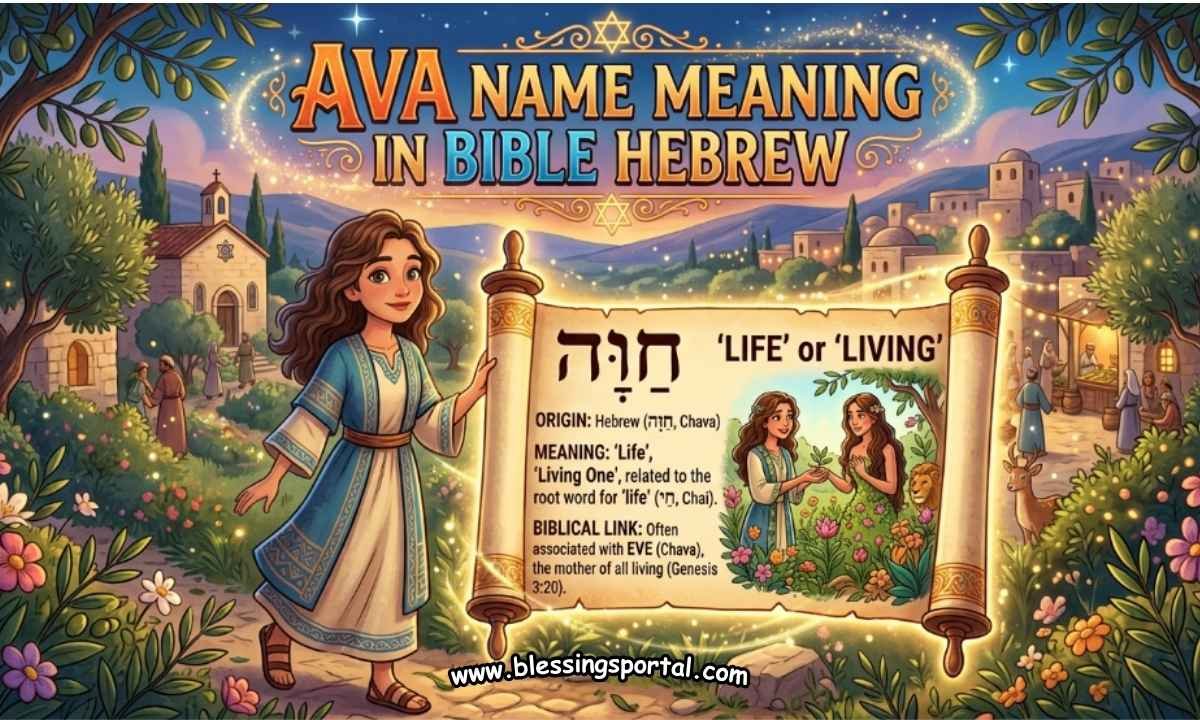
In Hebrew, the root behind Ava is generally traced to חַוָּה (Chavah), built from the Hebrew verb hayah, “to live” or “to breathe.” Some name scholars also connect Ava loosely to Hebrew words touching on breath or living spirit, though the clearest and most widely accepted link is the direct line to Chavah.
It’s worth being precise here: Ava is not a Hebrew word in its own right, and you won’t find it transliterated this way in a Hebrew Bible. What you will find is the shared root that also produced Eve, Chava, Chaya, and other “living” names still used today, particularly in Jewish naming traditions.
Ava Name Meaning in Bible Catholic
Ava Meaning in Bible Catholic context doesn’t include official recognition. Catholic tradition doesn’t treat Ava as a canonized name the way it does Mary, Anna, or Elizabeth. There’s no feast day tied to “Ava,” and it doesn’t appear in the Vulgate or in Catholic liturgical texts as a proper name.
That said, when people search Ava Meaning in Bible Catholic, it’s usually the Eve connection they’re after. Catholic parents often choose Ava for that same etymological link Eve, honored in Church teaching as the first woman and mother of humanity, referenced in Genesis and reflected on throughout the fall and redemption narrative. Some Catholic families also pair Ava with a more “official” confirmation name, such as Eve, Anne, or Maria, to anchor it within recognized Catholic naming customs.
Also Read This: 50+ Coldest Bible Verses: Powerful, Hard-Hitting & Shocking Scriptures
The Hebrew Root and Linguistic Origin of Ava (Chavah & Eve Connection)
To really understand where Ava comes from, it helps to walk through the actual chain of language rather than just accepting the surface-level claim that “Ava means life.”
The Hebrew name for Eve is חַוָּה, transliterated as Chavah or Havah, derived from the root ḥayah, “to live.” Genesis 3:20 explains that Adam named his wife Eve because she would become the mother of all living so the “life” meaning isn’t a stretch; it’s stated directly in the text.
From Chavah, the name moved through Greek and Latin translation. The Septuagint rendered it as Zoe (also meaning “life”), while later transliterations produced Eva in Latin and eventually Eve in English. Ava is widely considered a phonetic variant of Eva, sitting in the same linguistic family.
A secondary, less certain theory holds that Ava may also relate to old Persian or Latin roots tied to place names, entirely separate from the Hebrew connection. This alternate origin is rarely discussed in biblical naming contexts. If you’re choosing Ava for biblical significance specifically, the Eve connection is the one with real textual grounding.
Is the Name Ava Directly Mentioned in Scripture? (Bible Verses & References)
No the name “Ava,” spelled and pronounced the way we use it today, does not appear as a person’s name in any book of the Bible, in any translation. This is worth stating plainly, because a lot of name-meaning content implies a direct biblical presence that simply isn’t there.
What does appear is the place name Avva (sometimes rendered Ava or Ivvah depending on the translation), found in 2 Kings 17:24, 2 Kings 18:34, and Isaiah 37:13. These references describe a city in the Assyrian empire, not a person, and the context has nothing to do with the “life” meaning associated with Eve. It’s a separate word that happens to share a similar English spelling.
So when someone claims Ava “is in the Bible,” it’s technically true only in this narrow, geographic sense and understanding that distinction matters if you want an accurate picture rather than a comforting oversimplification.
Ava as a Place in the Bible (The Ancient City of Avva)
The city of Avva shows up in the account of the fall of the Northern Kingdom of Israel. After the Assyrian king conquered Samaria, he repopulated the region with people brought from several other conquered territories Babylon, Cuthah, Avva, Hamath, and Sepharvaim, according to 2 Kings 17:24.
The people relocated from Avva, referred to as Avvites, brought their own religious practices with them, including worship of gods identified in Scripture as Nibhaz and Tartak (2 Kings 17:31). This resettlement is part of a larger biblical narrative explaining why the region ended up with such a mixed religious population, later contributing to the tension between Jews and Samaritans seen elsewhere in the Bible.
Avva’s exact location is uncertain. Biblical scholars generally place it somewhere in the Assyrian or Mesopotamian region, though the precise site has never been definitively identified. It’s also referenced again, alongside Sepharvaim and Hena, in the Assyrian king’s boastful message to Hezekiah recorded in Isaiah 37:13 a passage where Assyria’s envoy lists conquered cities to intimidate Judah.
This part of the Ava story is genuinely biblical, but it’s a place, tied to conquest and idol worship, not a symbol of life or renewal. It’s an interesting historical footnote for the curious, though it’s not the reason most parents feel drawn to the name today.
Biblical and Spiritual Meaning of Ava (A Symbol of Life and Renewal)
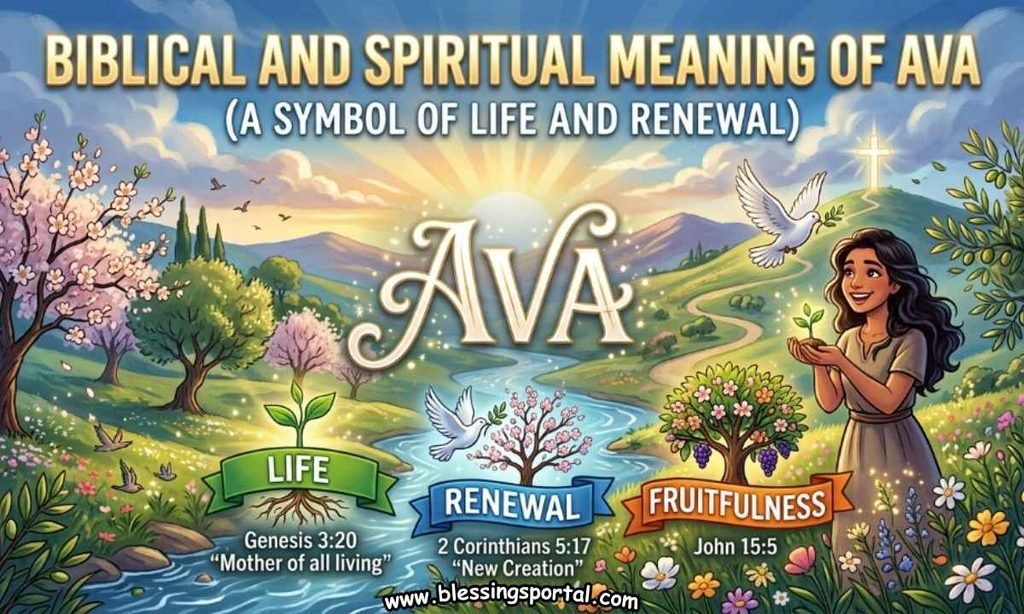
Setting the Avva place-name aside, the meaning most people associate with Ava spiritually comes back to its connection with Eve. Life, breath, vitality, and being the origin point of something new these are the themes name commentators consistently point to.
Some also draw a loose parallel to the broader biblical theme of renewal: Eve, despite being present at humanity’s fall, is also part of the story’s forward motion, since through her the human story continues. Christian writers sometimes lean into this duality a name touched by both consequence and continuation as a way of framing Ava as more layered than a simple “pretty and means life” summary would suggest.
It’s worth being honest that this is interpretive rather than doctrinal. The Bible doesn’t discuss the name Ava or assign it symbolic status; it discusses Eve, and Ava inherits meaning by linguistic association. That’s still a meaningful connection for many families it’s just accurate to describe it as inherited rather than direct.
Ava Name Meaning in Christian and Catholic Traditions
Across Christian denominations generally, Ava tends to be embraced less for formal theological reasons and more because it sits comfortably alongside other “life” and “grace” themed names Christian parents already favor, such as Chloe, Grace, Zoe, or Eve itself.
In Protestant naming traditions, there’s typically less emphasis on saints or canonization, so Ava is chosen more freely, mostly for its etymological tie to Eve. In Catholic households, Ava is sometimes paired with a more traditional saint’s name, since Eve herself isn’t a canonized saint the way Anne or Mary are though the biblical Eve remains significant in Catholic teaching, including her contrast with Mary as the “New Eve,” a concept developed by early Church theologians like Irenaeus, in which Mary’s faithfulness reverses Eve’s disobedience.
Biblical Character Traits Associated with the Name Ava
Since Ava has no direct biblical character of its own, any character traits associated with the name are borrowed from Eve’s portrayal in Genesis. That portrayal is more complex than “the woman who caused the fall,” which is how she’s sometimes reduced in casual retellings.
Genesis presents Eve as inquisitive, relational, and central to the creation narrative the first human companion, formed to address the statement that it was “not good” for the man to be alone. She’s also depicted as vulnerable to deception, part of the fall narrative, and later as a mother experiencing both the loss of Cain and Abel and the continuation of hope through further children.
Parents who connect Ava’s meaning to Eve sometimes highlight traits like:
- Life-giving and nurturing, tied directly to the “mother of all living” description
- Curiosity and depth, reflecting Eve’s role in the Eden narrative
- Resilience, given what Eve experienced after the fall and afterward
- New beginnings, since her story marks both an ending (Eden) and the start of human history as we know it
These aren’t official “biblical meanings of the name Ava” in a dictionary sense they’re thematic associations drawn from the one biblical figure Ava’s etymology most closely connects to.
Ava as a Divine Reminder of God’s Grace and Presence
Some Christian writers frame names connected to “life” as quiet reminders of God’s ongoing role as the giver of life a theological point made early in Genesis, where life itself is presented as something granted rather than self-generated.
Under that lens, a name like Ava can serve as a small, everyday nod to that idea. It’s the kind of meaning families sometimes lean on when choosing a name intentionally rather than just for sound not because Scripture singles the name out, but because its root concept (life, being) touches on something Scripture discusses constantly and considers sacred.
This is a matter of personal or family interpretation rather than settled theology, and it’s fine to hold it loosely. Plenty of parents choose meaningful names as a personal or devotional practice without expecting the Bible to have addressed that exact name.
Also Read This: Tristan Meaning in the Bible: Spiritual Meaning, Name Origin, and Biblical Symbolism
Biblical Meaning of Seeing the Name Ava in Dreams

Dream interpretation isn’t something the Bible provides a systematic framework for beyond specific narrative accounts Joseph’s dreams in Genesis, Daniel’s visions, and a handful of other examples. Scripture doesn’t offer a name-by-name dream dictionary, and any claim that seeing “Ava” in a dream carries a specific biblical meaning should be read as folk interpretation rather than scriptural teaching.
That said, within popular Christian dream-symbolism writing which draws more on tradition than on direct Bible verses a name tied to “life” appearing in a dream is sometimes read as a symbol of new beginnings or a season of personal renewal, occasionally linked to pregnancy given Eve’s association with motherhood.
It’s reasonable to find that kind of reflection meaningful on a personal level. Just don’t mistake it for a Bible-based teaching, since it isn’t one the Bible simply doesn’t comment on names appearing in dreams as a category.
Christian Middle Names and Sibling Names That Pair with Ava
If you’re drawn to Ava for its connection to Eve and the “life” meaning, a few pairing directions tend to work particularly well for families wanting the biblical thread to carry through the full name or sibling set.
Middle name pairings:
- Ava Grace
- Ava Faith
- Ava Ruth
- Ava Eve
- Ava Rose (a nod to renewal and new life imagery)
Sibling name pairings with biblical roots:
- Noah (renewal, new beginnings after the flood)
- Eli (a name tied to the priest Eli in 1 Samuel)
- Naomi (meaning “pleasantness,” from the Book of Ruth)
- Adam (the direct biblical counterpart to Eve)
- Elijah (one of the Bible’s most significant prophets)
These pairings aren’t rules they’re common patterns among families who want the biblical or spiritual thread in Ava’s meaning reflected elsewhere in the family’s names too.
Nicknames and Variations of the Name Ava with Biblical Meaning
Ava has several close variants and nicknames, many of which share the same Eve-rooted meaning:
| Variation | Origin/Connection |
| Eva | Latin form, direct predecessor to Ava |
| Eve | English form, the biblical name itself |
| Chava / Chavah | Original Hebrew form |
| Chaya | Hebrew, also touching on “life” |
| Avie / Avy | Informal nicknames for Ava |
| Zoe | Greek translation of Chavah, meaning “life” |
Choosing one of these instead of, or alongside, Ava is a common way for families to stay closer to the direct biblical name while still getting a modern sound. Some parents even use Eve or Chava as the “official” name and Ava as an everyday nickname, which keeps the biblical connection more explicit on paper.
Should Christian Parents Choose the Name Ava for Their Baby Girl?
There’s nothing in Scripture that discourages the name, and its closest biblical connection to Eve, the mother of all living is a positive and central figure in the creation narrative, not a negative one. Parents who want a name with quiet biblical roots, rather than an obviously “Bible name” like Sarah or Rebecca, often find Ava fits that goal well.
If having a more explicit, directly-biblical name matters to you, Eve, Chava, or Zoe are worth considering as alternatives or middle-name options, since they carry the same meaning with a more direct scriptural link. If the softer, indirect connection is enough, Ava works fine on its own.
FAQs
Is Ava a name in the Bible?
No. Ava isn’t written in the Bible as a person’s name, but it comes from the Hebrew Chavah (Eve), meaning “life.”
What does the name Ava mean spiritually?
Ava is spiritually associated with life, renewal, and new beginnings, based on its root connection to Eve in Genesis.
Where is Ava mentioned in the Bible?
As a name, it isn’t. But Avva, spelled similarly, appears in 2 Kings 17:24 as a conquered Assyrian city.
Is Ava a Christian name?
Yes. Many Christian and Catholic parents choose Ava for its link to Eve, the “mother of all living.”
Can Christian parents give their daughter the name Ava?
Yes. Many Christian and Catholic families choose Ava specifically because of its connection to Eve and the theme of life it carries.
Conclusion
Ava’s story is really two stories folded into one name: a modern favorite quietly carrying the linguistic DNA of Eve, and a nearly forgotten Assyrian city that shows up in the middle of a very different biblical account. Most people searching for meaning in the name are looking for the first one and it holds up.
The connection to Chavah and the theme of life is real, well-documented, and worth feeling good about if it’s part of why you love the name. Just hold the rest of the folklore the dream meanings, the “hidden signs” claims a little more loosely than the Genesis text itself.
Also Read This: How Old Would Jesus Be Today in 2026? The Real Answer Explained

With 4 years of experience writing about blessings and positive living, William Parker is passionate about creating heartfelt content that inspires faith and gratitude. Their mission is to provide readers with daily blessings and uplifting words that brighten lives and nurture inner peace.
2 thoughts on “Ava Name Meaning in the Bible: Biblical Origin, Spiritual Significance & Scripture Facts”