
Every December, someone in a family group chat does the math out loud: if Jesus was born year one, and it’s currently 2026, doesn’t that make him 2,026 years old? It sounds like a simple subtraction problem. It isn’t. The calendar we use to track “years since Jesus” wasn’t actually built by anyone who knew when he was born, and the person who designed it made a mistake that historians only caught centuries later.
So if you’ve ever tried to answer this at a dinner table and gotten stuck, you’re not missing something obvious. The math is genuinely a little broken. Here’s what the historical evidence actually says.
Also Read This: 40 Powerful Prayer Points for Church Growth With Bible Verses
How Old Would Jesus Be Today in 2026?
Based on the most widely accepted scholarly estimate that Jesus was born around 6 to 4 BC, he would be approximately 2,030 to 2,032 years old in 2026. That’s older than the “2,026 years old” figure most people assume, and the gap exists for one specific reason: the calendar system itself places his birth a few years earlier than year 1.
There’s no single, universally agreed-upon number, because the exact birth year isn’t recorded anywhere with certainty. What historians and biblical scholars can do is narrow the range using historical events mentioned in the Gospels, which is how the 6–4 BC estimate was reached.
How Old Would Jesus Be in 2026 If He Were Alive Today?
This is really the same question asked a different way, and it’s worth separating from the theological question of whether Jesus is still alive (more on that below). Purely as an age calculation:
- If born in 6 BC, Jesus would be 2,032 in 2026.
- If born in 5 BC, he would be 2,031.
- If born in 4 BC, he would be 2,030.
Most historical timelines lean toward 4 BC, largely because of its connection to the death of King Herod the Great, who plays a role in the nativity accounts in Matthew’s Gospel. That makes 2,030 the figure you’ll see cited most often, though you’ll also come across 2,032 depending on which scholar’s estimate a source is using.
When Was Jesus Actually Born?

Here’s where it gets interesting. The Gospel of Matthew places Jesus’s birth during the reign of Herod the Great, who historical records indicate died in 4 BC. If that timeline is accurate, Jesus must have been born before 4 BC, not in the year 1 that the calendar implies.
Luke’s Gospel adds another clue, referencing a census under Quirinius, the Roman governor of Syria. Historians have long debated exactly when that census took place, and reconciling it with Herod’s reign has kept scholars busy for a very long time. Most conclude the birth happened somewhere in the 6–4 BC window, even though the two Gospel accounts don’t line up as neatly as we’d like.
As for the time of year, December 25 wasn’t chosen because of any recorded birth date. It was established centuries later, likely tied to existing Roman winter festivals and theological symbolism around the winter solstice, rather than any historical record of the actual day.
Also Read This: Powerful Bible Scriptures on Salvation (Faith, Grace & Eternal Life)
What Year Was Jesus Born?
The short answer: most historians place it between 6 BC and 4 BC, with 4 BC being the most commonly cited single estimate.
That might sound backwards. How can someone be born “before” the calendar era that’s supposedly counting from their birth? That contradiction is exactly why this whole topic trips people up, and it comes down to a calculation error made roughly 500 years after the fact.
How Many Years Ago Was Jesus Born?
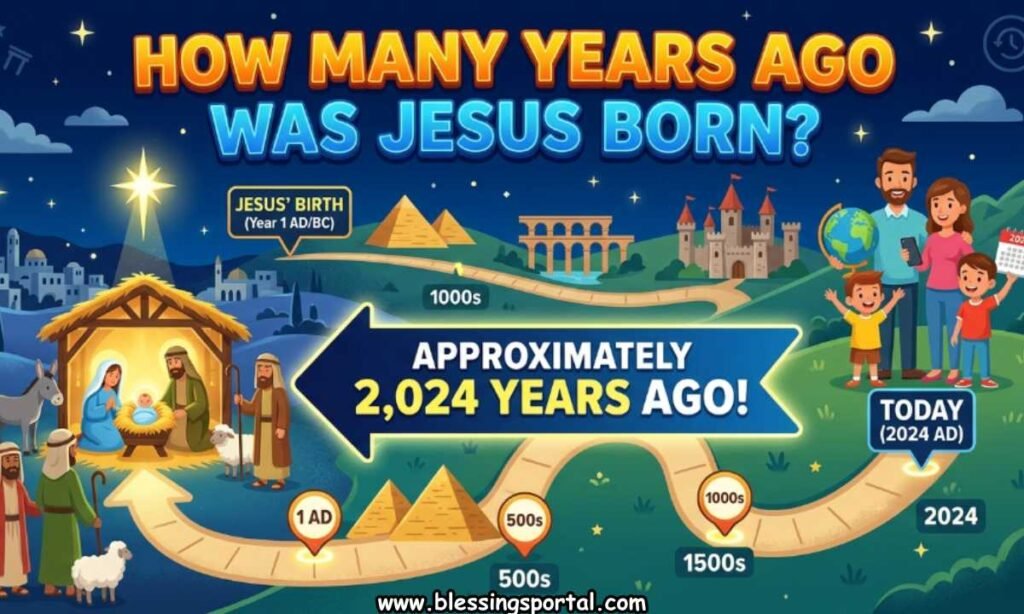
If Jesus was born in 4 BC, then as of 2026, that’s 2,030 years ago. Using the 6 BC estimate instead pushes that to 2,032 years ago. Either way, it’s more than the “2,026 years” figure that a quick, calendar-literal subtraction would suggest, again because of the gap between the calendar’s starting point and Jesus’s actual estimated birth year.
Why Was Jesus Not Born in Year 0?
There is no year 0 in the calendar we use, which is part of the answer, but it’s not the whole story. Even setting that aside, the calendar’s starting point simply doesn’t match the historical evidence for when Jesus was born.
The calendar era we use today, called Anno Domini (Latin for “in the year of the Lord”), was created in the year 525 AD by a monk named Dionysius Exiguus. He was working on tables to calculate the date of Easter and decided to number the years from what he believed was the year of Jesus’s birth, replacing the older Roman practice of counting years from the founding of Rome.
The problem is that Dionysius didn’t have access to the historical records we have now, and his estimate was off by a handful of years. By the time later scholars cross-referenced his calendar against Roman records like Herod’s death, the discrepancy became clear. But by then, the AD/BC system was already in widespread use, and it was far too late to renumber every year in Europe. So the calendar stuck, mistake and all.
Why Is There No Year 0 Between BC and AD?
The calendar jumps directly from 1 BC to AD 1, with no year 0 in between. This wasn’t a deliberate theological statement; it’s simply because Dionysius Exiguus was using Roman numerals, and the concept of zero as a number hadn’t been introduced into Western mathematics yet. Roman numeral systems had no symbol for zero, so counting started at one.
This absence of a year 0 is also why age calculations across the BC/AD boundary always feel slightly off. If you’re calculating the age of anything born in, say, 5 BC, and want to know their age in a given AD year, you can’t simply subtract 5 from the AD year. You have to add one back in to account for the missing year 0. It’s a small detail, but it trips up a lot of casual calculations, including this one.
How Old Was Jesus When He Died?
According to most historical and Gospel-based estimates, Jesus was crucified around AD 30 to AD 33, most commonly placed around AD 30 or AD 33. Combined with a birth year of roughly 4 BC, that would put him at approximately 33 to 36 years old at the time of his death, with 33 being the figure most frequently cited in both religious and historical sources.
This is also where the phrase “died at 33” comes from in popular culture, and it lines up reasonably well with the historical estimates, even though, as with the birth year, there’s no exact recorded date.
Is Jesus Still Alive According to Christianity?

This question sits outside historical calculation and moves into theology, so it’s worth answering on its own terms rather than folding it into the age math above.
Christian doctrine holds that Jesus died, was resurrected, and ascended into heaven, and that he remains alive in a spiritual and divine sense rather than a physical, earthly one. This belief in the resurrection is central to Christian theology and is why Christians don’t typically talk about calculating Jesus’s “current age” the way you would for a historical figure who is simply deceased. The age question in this article is a historical exercise; the theological answer to whether Jesus is alive is a matter of religious belief, not calendar arithmetic.
Also Read This: 280+ Best Bible Verses for Instagram Bio (2026) | Short, Aesthetic & Powerful Scriptures
What Does AD Mean and How Is It Related to Jesus?
AD stands for Anno Domini, Latin for “in the year of our Lord,” and it refers to the years counted after the estimated birth of Jesus. BC, by contrast, stands for “Before Christ” and counts backward from that same starting point.
Together, AD and BC form the Gregorian-adjacent dating system used across most of the world today, even in secular and non-Christian contexts. That’s actually why many academic, scientific, and international publications now use CE (“Common Era”) and BCE (“Before Common Era”) instead. These use the exact same numbering system and the exact same starting point; they just remove the explicit religious framing from the terminology, which makes the system more usable in a global, multi-faith context.
So whether a source says “AD 2026” or “2026 CE,” it’s referring to the identical year, counted from the same (slightly inaccurate) starting point established by Dionysius Exiguus in the sixth century.
Frequently Asked Questions
Why do different sources give different ages for Jesus?
Because the exact birth year isn’t recorded, scholars work from a range (6–4 BC) rather than a single confirmed date. Depending on which end of that range a source uses, the resulting age in any given year will shift by a couple of years.
Is the 4 BC birth year definitely correct?
It’s the most widely cited estimate, largely tied to Herod the Great’s death, but it’s still an estimate rather than a confirmed historical fact. Some scholars argue for 5 or 6 BC based on other historical cross-references.
Does the “no year 0” issue affect other historical age calculations too?
Yes. Any calculation that spans the BC/AD boundary needs an adjustment of one year, since the calendar goes straight from 1 BC to AD 1. This applies to historical figures generally, not just to Jesus.
Why does December 25 matter if it’s not his real birthday?
December 25 became the traditional date for celebrating Jesus’s birth for theological and cultural reasons that developed over the following centuries, not because it reflects a historical record. The actual season, or even year, of his birth remains a matter of historical estimation rather than documented fact.
Conclusion
The number that satisfies a search engine is easy enough: somewhere around 2,030 to 2,032, depending on which historical estimate you go with. But the more useful thing to take away is why the math doesn’t line up the way most people expect. The calendar counting up to 2026 wasn’t built by someone with access to a birth certificate; it was built centuries later by a monk doing his best with the records he had, and he got it slightly wrong in a way that’s now permanently baked into how the entire world tracks time. That’s a more interesting fact than the age itself, and it’s the reason this question keeps coming up every year without ever having one clean, final answer.
Also Read This: Bible Verses For Exam Success, Studying, and Preparation

With 4 years of experience writing about blessings and positive living, William Parker is passionate about creating heartfelt content that inspires faith and gratitude. Their mission is to provide readers with daily blessings and uplifting words that brighten lives and nurture inner peace.
2 thoughts on “How Old Would Jesus Be Today in 2026? The Real Answer Explained”