
There’s a reason the phrase “biblically accurate angels” became a small internet phenomenon a few years back. Someone posted an image of a being made of wheels and eyes, captioned it with a verse from Ezekiel, and thousands of people reacted with the same mix of fascination and unease: wait, that’s actually in the Bible?
It is. And it’s a useful entry point, because it exposes a gap most people don’t realize exists. The angel most of us picture a serene figure in a white robe, maybe with a harp, definitely with soft feathered wings comes almost entirely from Renaissance painting, greeting cards, and centuries of devotional art. The Bible describes something considerably stranger, more varied, and in places, more unsettling.
This article walks through what Scripture actually says about angels: their appearance, their ranks, their names, their assignments, and the parts of the story like fallen angels and the mysterious “sons of God” in Genesis that rarely make it into Sunday school. Some of it will match what you already believe. Some of it won’t.
Also Read This: 31 Scriptures to Pray for Your Pastor (31-Day Biblical Prayer Guide & Prayer Points)
What Do Angels Look Like According to the Bible?
There’s no single biblical answer to this, because Scripture doesn’t describe one type of angel it describes several, and they don’t all look alike.
When angels appear to deliver messages or interact with people directly, they usually look human. Abraham serves a meal to three visitors who turn out to be divine messengers (Genesis 18). Two angels who look like ordinary men visit Lot in Sodom (Genesis 19). The angel who rolls back the stone at Jesus’ tomb is described in Matthew 28:3 as having an appearance “like lightning” and clothing “white as snow” striking, but still recognizably a single figure with a face and a form.
Then there’s everything else. Seraphim in Isaiah 6 have six wings and hover around God’s throne calling out in worship. Cherubim, described across Genesis, Exodus, and Ezekiel, are composite beings with multiple faces human, lion, ox, and eagle in Ezekiel’s version. And the ophanim, the “wheels” of Ezekiel’s vision, are rings within rings, their rims described as “full of eyes all around” (Ezekiel 1:18).
So the honest, if unsatisfying, answer is: it depends which kind of angel, and which biblical writer is describing it. That variety is the whole reason this topic keeps generating curiosity the Bible simply doesn’t flatten angels into one tidy image.
The Biblical Foundation of Angels
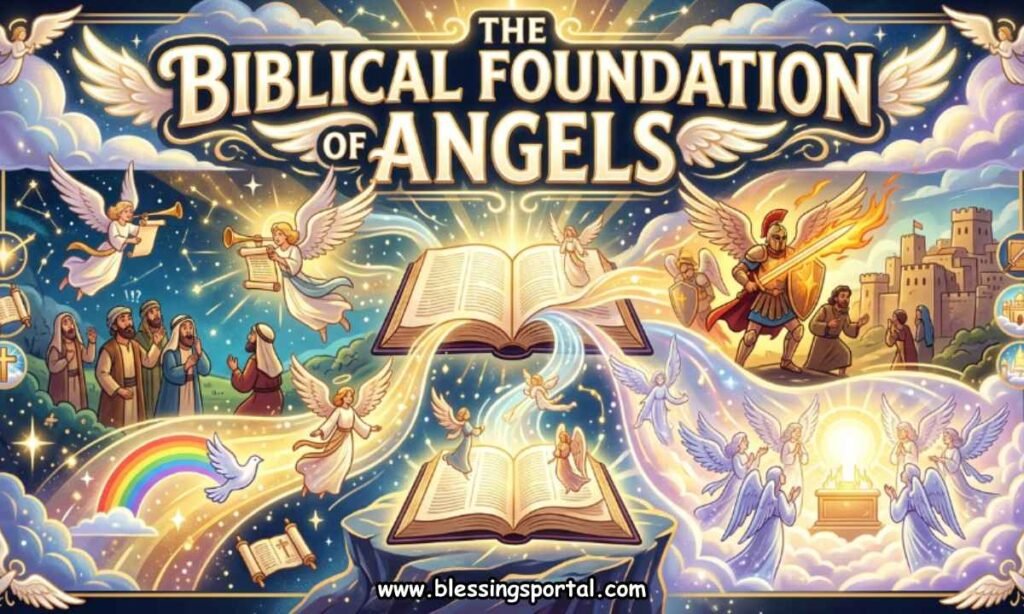
What Scripture Reveals About Angels?
Angels appear in nearly every section of the Bible, from Genesis to Revelation, and they show up doing a wide range of jobs: delivering messages, executing judgment, protecting people, worshiping God, and occasionally engaging in what can only be described as combat. They are never portrayed as objects of worship themselves in fact, Revelation 22:8-9 shows John being corrected by an angel for trying to bow to one.
What Scripture consistently avoids is a systematic field guide. No single passage lays out every angel type, rank, and function in one place. Instead, the picture is built gradually, book by book, vision by vision which is part of why so much confusion (and so much speculative art) has filled in the gaps over the centuries.
The Etymology and Meaning of “Angel”
The English word “angel” comes from the Greek angelos, meaning “messenger.” The Hebrew equivalent, mal’akh, carries the same core idea. Neither word says anything about wings, robes, or halos it’s a job title, not a physical description. That’s worth sitting with, because it means the word itself tells us angels are defined by function (they deliver messages and carry out God’s will) rather than by appearance.
This is also why the same Hebrew or Greek word can refer to a human messenger in one verse and a heavenly being in another context, not vocabulary, tells you which is meant.
Angels as Spiritual Beings and Ministering Spirits
Hebrews 1:14 sums up their role plainly, describing angels as “ministering spirits sent out to serve those who will inherit salvation.” They’re consistently portrayed as created beings not eternal, not divine, but spirit beings who exist to carry out God’s purposes. Colossians 1:16 lists them among the “thrones,” “powers,” “rulers,” and “authorities” created through Christ, which suggests a more layered spiritual reality than a flat crowd of identical winged figures.
Types of Angels in the Bible
Scripture doesn’t hand over a numbered list, but piecing together the named categories gives a reasonably clear picture:
- Seraphim – six-winged beings seen worshiping around God’s throne (Isaiah 6)
- Cherubim – multi-faced guardian beings associated with God’s presence and holiness (Genesis, Exodus, Ezekiel)
- Living creatures (Chayot) – four-faced beings tied to Ezekiel’s throne vision and echoed in Revelation 4
- Ophanim – the wheel-like beings covered in eyes, closely linked to the living creatures
- Archangels – higher-ranking messengers, with Michael explicitly called an archangel in Jude 1:9
- General angels/messengers – the broad category responsible for most appearances in Scripture, usually shown in human form
Not every scholar categorizes these the same way, and the Bible itself sometimes blurs the lines between them (more on that below). But this is the working framework most careful readers use.
Biblically Accurate Angels and Their Roles
Function matters as much as form in the biblical record. Angels announce births (Gabriel to Mary in Luke 1), deliver warnings (an angel warning Joseph to flee to Egypt in Matthew 2:13), protect individuals (an angel shutting the mouths of lions for Daniel in Daniel 6:22), carry out judgment (the angel who struck down Herod in Acts 12:23), and battle spiritual opposition (Michael contending with the devil over Moses’ body in Jude 1:9).
They also worship. Seraphim in Isaiah’s vision do nothing but declare God’s holiness. Revelation’s living creatures do the same, endlessly. Angels, in other words, aren’t just a heavenly delivery service worship appears to be as central to their existence as their errands.
Description of Angels in the Bible KJV
Readers researching this topic often want the language exactly as it appears in the King James Version, since its phrasing shaped so much of Western angel imagery. A few of the most vivid KJV descriptions:
- Ezekiel 1:18 on the wheels: “their rings were so high that they were dreadful; and their rings were full of eyes round about them four.”
- Isaiah 6:2 on the seraphim: “each one had six wings; with twain he covered his face, and with twain he covered his feet, and with twain he did fly.”
- Daniel 10:6 describing a heavenly figure (widely understood as angelic): “his body also was like the beryl, and his face as the appearance of lightning, and his eyes as lamps of fire.”
- Matthew 28:3 on the angel at the tomb: “His countenance was like lightning, and his raiment white as snow.”
None of these read like the gentle, pastel-toned angels of popular art. The KJV’s language leans toward the overwhelming fire, lightning, brass, and eyes which is one reason the “biblically accurate angel” meme resonated so widely when people rediscovered it.
Also Read This: How Old Would Jesus Be Today in 2026? The Real Answer Explained
The Angelic Hierarchy: What the Bible Says About Heavenly Beings
Biblical Evidence for Angelic Ranks
Scripture hints at rank without ever fully spelling one out. Michael is called “one of the chief princes” in Daniel 10:13 and “the archangel” in Jude 1:9, implying a tier above ordinary messengers. Paul’s letters mention “thrones,” “dominions,” “principalities,” and “powers” (Colossians 1:16, Ephesians 6:12) as distinct categories of spiritual beings, which suggests some kind of structured order even if Paul never explains exactly how they relate to one another.
Beyond that, the evidence gets thin. The Bible gives fragments, not an org chart.
The Pseudo-Dionysius Framework and Its Influence
Much of the popular nine-tier angelic hierarchy seraphim, cherubim, and thrones in the highest triad; dominions, virtues, and powers in the middle; principalities, archangels, and angels in the lowest comes not from the Bible but from a 5th or 6th century Christian theologian writing under the name “Dionysius the Areopagite” (a name borrowed from a convert mentioned in Acts 17:34, though the actual author is unknown to history, hence “Pseudo-Dionysius”). His work, The Celestial Hierarchy, synthesized scattered biblical terms into a single, systematic structure.
This framework became enormously influential in medieval theology and art, and it’s the reason so many people assume the Bible itself teaches a nine-rank angel system. It doesn’t Pseudo-Dionysius built a coherent model out of biblical vocabulary, but the model itself is a later theological construction, not a direct scriptural claim.
Why Does This Hierarchy Matter?
Understanding the difference between what’s in the Bible and what was added later matters for basic accuracy it’s easy to mistake church tradition for scriptural fact, especially with a topic as visually rich as angels. It also helps explain why angel imagery varies so much between traditions: Catholic, Orthodox, and Protestant depictions often draw on different measures of biblical text versus later theological development.
Biblical Angels vs. Modern Angel Artwork
How Modern Media Misrepresents Angels
Most popular angel imagery chubby cherubs, women in flowing robes, gentle figures with dove-like wings has more in common with Greco-Roman art and Renaissance painting than with the biblical text. Cupid-style cherubs, in particular, descend from classical depictions of Eros, not from the multi-faced guardian beings described in Ezekiel. Over centuries, these artistic traditions blended with Christian iconography until the two became hard to separate in the popular imagination.
None of this makes the art meaningless devotional art has its own purpose and history but it does mean most people’s mental picture of an angel is shaped more by centuries of painting than by the biblical text itself.
Why Angels Say “Fear Not” in Scripture
Here’s a detail that often gets missed: nearly every time an angel appears to a human in Scripture, the first words out of its mouth are some version of “do not be afraid.” Gabriel says it to Zechariah (Luke 1:13) and to Mary (Luke 1:30). An angel says it to the shepherds (Luke 2:10). This isn’t a stylistic tic it’s a strong clue about how overwhelming and unsettling an actual angelic appearance was. A being that looked like a soft, harmless figure in a nightgown wouldn’t need to open with a reassurance against terror.
Archangels: The Named Messengers of Heaven
Michael: The Warrior Prince
Michael is the only angel explicitly called an “archangel” in Scripture (Jude 1:9), and he’s consistently associated with conflict and protection. Daniel 10 and 12 describe him as a guardian prince connected to Israel. Revelation 12:7 shows him leading heaven’s forces against “the dragon” in a decisive battle. Across these passages, Michael functions less like a messenger and more like a commander.
Gabriel: God’s Chief Herald
Gabriel appears by name in Daniel 8 and 9, and later in Luke 1, where he announces the births of both John the Baptist and Jesus. Unlike Michael, Gabriel’s role is consistently about delivering and explaining messages often complex ones, as when he interprets Daniel’s visions. If Michael is the warrior, Gabriel is the herald.
The Unique Role of Named Angels
It’s worth noting how rare named angels actually are in Scripture. Michael and Gabriel are the only two angels named in the Protestant canon (some traditions also recognize Raphael from the deuterocanonical Book of Tobit). Given how many unnamed angels appear throughout the biblical narrative, this scarcity suggests names were reserved for angels with particularly significant, recurring assignments not handed out as a matter of course.
Seraphim: The Fiery Worshipers at God’s Throne
The Six Wings and Their Symbolic Meaning
Isaiah 6:2 describes seraphim with six wings, each pair serving a different purpose: two cover the face, two cover the feet, and two are used for flight. The covering of the face suggests even these exalted beings cannot look directly upon God’s full glory. The covering of the feet is often read as a gesture of humility or modesty before holiness. Only one pair is left free for movement a striking detail, since it implies these beings spend most of their existence in a posture of reverence rather than action.
The Threefold Holy Proclamation
The seraphim’s declaration in Isaiah 6:3 “Holy, holy, holy is the Lord of hosts” is one of the most quoted lines in the entire Bible, echoed centuries later in Revelation 4:8. The triple repetition is a Hebrew intensifier, a way of expressing the superlative degree of something (similar to saying “the holiest of the holy”), and it has shaped Christian liturgy ever since through hymns and prayers built directly on this verse.
Seraphim’s Role in Purification
Immediately after the vision, a seraph takes a burning coal from the altar and touches it to Isaiah’s lips, declaring his guilt atoned for (Isaiah 6:6-7). This is the seraphim’s only recorded action beyond worship in Scripture and it directly connects them to purification and the removal of guilt, reinforcing their association with holiness rather than simple messenger duties.
Cherubim: The Multi-Faced Guardians of Holy Places
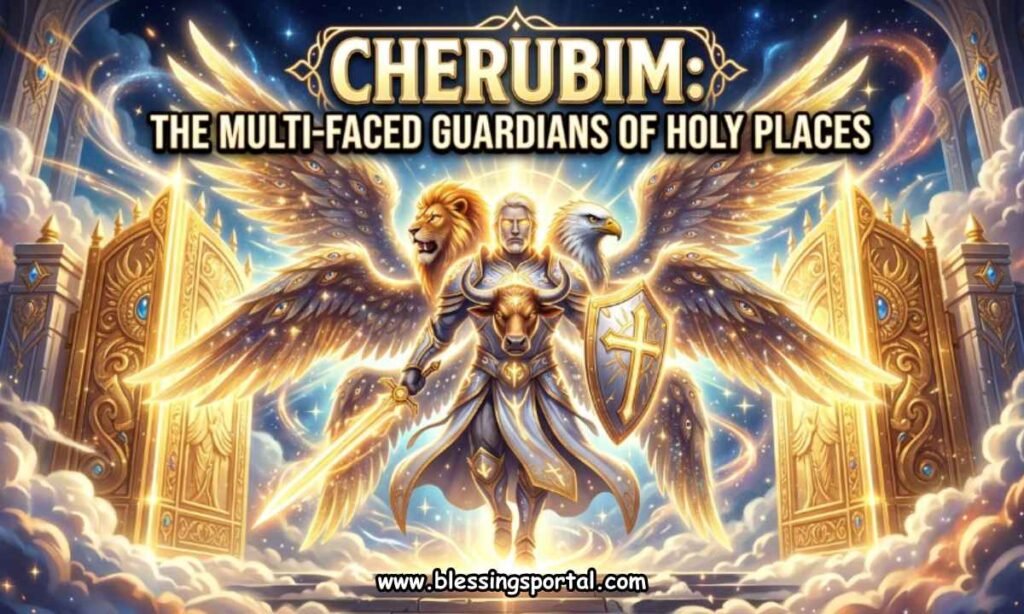
Cherubim Guarding the Garden of Eden
The very first mention of any angelic being in the Bible is a cherub actually, cherubim, plural stationed at the entrance to Eden after Adam and Eve are expelled, along with “a flaming sword flashing back and forth,” to guard the way to the tree of life (Genesis 3:24). This sets the tone for their role throughout Scripture: cherubim guard access to sacred space.
The Four Faces and Their Significance
Ezekiel’s vision describes cherubim with four faces each: a human, a lion, an ox, and an eagle (Ezekiel 1:10, 10:14). Various interpretations have been proposed over the centuries some see the four faces as representing the pinnacle of each domain of creation (humanity, wild animals, domestic animals, and birds), while others connect them to later Christian tradition linking each face to one of the four Gospel writers. The Bible itself doesn’t explain the symbolism directly, so any interpretation here is reasoned inference rather than stated fact.
Cherubim on the Ark of the Covenant
God instructs Moses to have two golden cherubim crafted on the cover of the Ark of the Covenant, facing each other with wings spread over the mercy seat (Exodus 25:18-20). This is where God tells Moses He will meet with him and speak (Exodus 25:22) making the cherubim, quite literally, the guardians flanking the point of contact between God and Israel.
Eyes Symbolizing God’s Omniscience
Ezekiel 10:12 describes the cherubim (and their attending wheels) as “full of eyes all around.” Whatever else this detail is meant to convey, the eyes are widely understood as a symbol of complete awareness nothing escapes the notice of these beings, mirroring the all-seeing nature of the God they surround.
Are Seraphim, Cherubim, and Ophanim Angels?
This is a fair question, because the Bible never uses the Hebrew word for “angel” (mal’akh) to describe seraphim, cherubim, or ophanim directly. Isaiah 6 doesn’t call the seraphim angels. Ezekiel doesn’t call the living creatures or wheels angels either.
Most theologians still classify them within the broader category of angelic or heavenly beings, since they’re spiritual beings created by God who serve in His presence but strictly speaking, “angel” in its narrowest biblical sense refers to messengers, and seraphim, cherubim, and ophanim aren’t shown delivering messages the way Gabriel or the angel of the Lord do. It’s more accurate to say the Bible describes several distinct categories of heavenly beings, of which “messenger angels” are just one a nuance that gets lost when everything gets lumped under the single umbrella term “angel.”
Living Creatures and Ophanim: The Most Mysterious Heavenly Beings
Ezekiel’s Vision of the Living Creatures
Ezekiel 1 opens with one of the strangest visions in the entire Bible: four living creatures, each with four faces and four wings, moving in perfect unison, accompanied by wheels that move with them. Fire moves back and forth among them, and the whole scene is framed by a description of divine glory so overwhelming that Ezekiel falls facedown (Ezekiel 1:28). Later, in Ezekiel 10, these same beings are explicitly identified as cherubim (Ezekiel 10:20), linking the “living creatures” and “cherubim” terminology together.
What Are Ophanim? The Wheels Within Wheels Explained
The ophanim (from the Hebrew ophan, meaning “wheel”) appear alongside the living creatures as “a wheel within a wheel” (Ezekiel 1:16) commonly understood as two wheels intersecting at right angles, allowing movement in any direction without turning. They move exactly in step with the living creatures, described as sharing “the spirit of the living creatures” (Ezekiel 1:20-21), which suggests the wheels aren’t simply mechanical objects but are themselves alive in some sense.
Wheels Within Wheels Covered With Eyes
As noted above, Ezekiel 1:18 describes the rims of these wheels as “full of eyes all around.” This is almost certainly the single most-referenced detail behind the modern “biblically accurate angel” internet imagery a striking, unsettling picture that has little in common with conventional angel art, but is drawn directly and accurately from the biblical text.
The Relationship Between Living Creatures and Cherubim
Ezekiel’s own text resolves what could otherwise be a confusing question: the living creatures of chapter 1 and the cherubim of chapter 10 are the same beings, described from two different vantage points in the prophet’s visions. This means “living creatures,” as used by Ezekiel (and later echoed in Revelation 4), and “cherubim,” as used elsewhere in the Old Testament, refer to overlapping likely identical categories of heavenly beings.
General Angels: The Messengers Throughout Scripture
Angels Appearing in Human Form
The vast majority of angelic appearances in the Bible involve beings who look, act, and are treated as ordinary men. Abraham’s three visitors eat a meal (Genesis 18:8). The men who visit Lot are nearly assaulted by a mob who treat them as human guests (Genesis 19:5). Hebrews 13:2 even warns believers to show hospitality to strangers, “for by so doing some people have entertained angels without knowing it” a verse that only makes sense if angels in human form were genuinely indistinguishable from ordinary travelers.
The Mighty Acts Angels Perform
Beyond delivering messages, angels in Scripture perform physical feats: rolling away the stone from Jesus’ tomb (Matthew 28:2), striking Sodom’s attackers with blindness (Genesis 19:11), freeing Peter from prison by causing his chains to fall off (Acts 12:7), and striking down 185,000 soldiers in a single night during Hezekiah’s reign (2 Kings 19:35). These accounts consistently portray angels as beings of considerable power acting under direct divine command, not passive spectators.
Angels Holding Swords as Warriors
The image of an angel with a sword appears at key moments: the cherubim guarding Eden with a flaming sword (Genesis 3:24), the angel of the Lord blocking Balaam’s donkey with a drawn sword (Numbers 22:23), and the “commander of the Lord’s army” who appears to Joshua with a drawn sword before the conquest of Jericho (Joshua 5:13-14). This martial imagery reinforces that angels, in the biblical imagination, are frequently agents of confrontation and judgment, not exclusively gentle messengers.
The Angel of the Lord: Messenger, Theophany, or Pre-Incarnate Christ?
Biblical Appearances of the Angel of the Lord
“The angel of the Lord” is a distinct and recurring figure across the Old Testament: appearing to Hagar in the wilderness (Genesis 16:7-13), stopping Abraham’s hand at the sacrifice of Isaac (Genesis 22:11-12), speaking to Moses from the burning bush (Exodus 3:2), and appearing to Gideon (Judges 6:11-24) and to Manoah and his wife before the birth of Samson (Judges 13). In several of these accounts, the angel of the Lord speaks in the first person as God (“I am the God of your father,” Exodus 3:6), which sets this figure apart from ordinary messenger angels.
Is the Angel of the Lord a Pre-Incarnate Christ?
Many theologians hold that “the angel of the Lord” represents a pre-incarnate appearance of the Son of God a theophany, meaning a visible manifestation of God, that occurs before Christ’s birth in human flesh. The reasoning centers on passages where this figure both identifies as God’s messenger and speaks with God’s own authority and identity in the same breath. Other scholars read this more cautiously, treating “the angel of the Lord” as a unique, unrepeated title without asserting a specific christological identity. Scripture itself doesn’t settle this definitively, so it remains a matter of interpretation rather than explicit statement worth knowing if you encounter confident claims on either side.
Angels in the Life and Ministry of Christ
Angelic Announcements of Jesus’ Birth
Angels frame the entire nativity narrative: Gabriel announces the coming birth to Mary (Luke 1:26-38), an angel reassures Joseph and instructs him to take Mary as his wife (Matthew 1:20-21), and a multitude of “the heavenly host” appears to shepherds outside Bethlehem, praising God (Luke 2:13-14).
Angels Ministering to Jesus During His Earthly Life
After Jesus resists temptation in the wilderness, Matthew 4:11 records that “angels came and attended him.” A similar moment occurs in Gethsemane, where Luke 22:43 describes an angel appearing to strengthen Jesus before His arrest. These moments show angels in a supportive, ministering role even toward the Son of God himself.
Angels at the Resurrection and Ascension
An angel (or in some Gospel accounts, two) is present at the empty tomb, announcing the resurrection to the women who arrive to anoint Jesus’ body (Matthew 28:2-7, Luke 24:4-7). Later, at the ascension, “two men in white” again, understood as angels tell the watching disciples that Jesus will return in the same way he departed (Acts 1:10-11).
Jesus’ Teaching About Angels and Judgment
Jesus refers to angels repeatedly in His own teaching, describing them as present at final judgment (Matthew 13:39, 41, 49), stating that in heaven people “neither marry nor are given in marriage, but are like the angels” (Matthew 22:30), and warning that even He does not know the day or hour of His return a knowledge withheld even from “the angels in heaven” (Mark 13:32). This last detail is notable: it places angels below the Son in the order of divine knowledge, reinforcing their status as created, limited beings rather than omniscient ones.
Angelic Activity in Acts and the Early Church
Angels Guiding the Spread of the Gospel
Angels repeatedly direct the early church’s mission: an angel tells Philip to head toward the road where he meets the Ethiopian official (Acts 8:26), and an angel appears to Cornelius, setting in motion the events that lead to the gospel reaching Gentiles (Acts 10:3-6).
Angels Executing Divine Judgment
Acts 12:23 records one of the more sobering angelic acts in Scripture: an angel strikes down Herod Agrippa after he accepts worship as though he were a god, and he dies shortly after. It’s a stark reminder that biblical angels are just as capable of judgment as of comfort.
Paul’s Theological Insights About Angels
Paul treats angels as a settled part of the spiritual landscape rather than a topic needing introduction. He references “thrones,” “powers,” “rulers,” and “authorities” as categories of spiritual beings (Colossians 1:16), warns against improper angel worship (Colossians 2:18), and states that believers will one day judge angels (1 Corinthians 6:3) a claim that assumes a great deal about the future relationship between humanity and angelic beings without fully explaining it.
Also Read This: William Meaning in Bible: Truth, Symbolism, and Spiritual Insights
Angels in the Book of Revelation
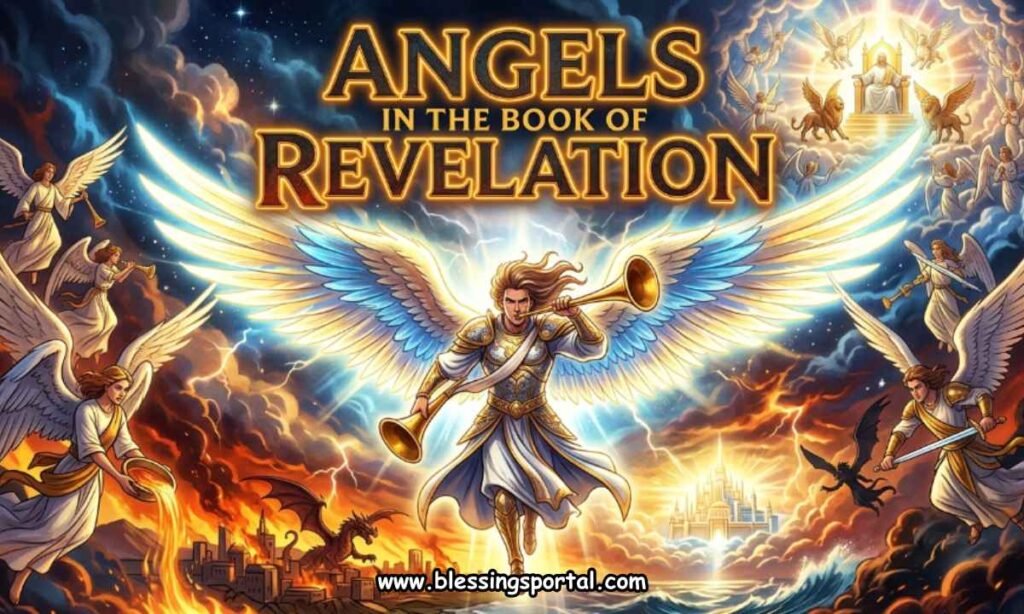
Seven Angels With Seven Trumpets
Revelation 8-9 describes seven angels who each sound a trumpet, triggering a sequence of escalating judgments on the earth. This is one of the most structurally significant angelic sequences in the Bible, forming the backbone of a major section of Revelation’s plot.
Angels Pouring Out God’s Wrath
In Revelation 16, seven angels pour out “bowls” of God’s wrath, an escalation that follows and intensifies the trumpet judgments. The imagery throughout this section positions angels as direct executors of divine judgment on a global scale.
Michael’s War Against the Dragon
Revelation 12:7-9 depicts Michael and his angels fighting against “the dragon” identified in the text as Satan and casting him down to earth. It’s the most explicit combat scene involving angels anywhere in Scripture, and it cements Michael’s role as heaven’s principal warrior figure.
The Angel Binding Satan
Revelation 20:1-3 describes an unnamed angel descending with a key and a great chain, binding Satan for a thousand years. Unlike Michael’s battle in chapter 12, this angel isn’t named, which is consistent with how rarely Scripture assigns names to angels even during pivotal events.
The Biblical Truth About Guardian Angels
What Scripture Actually Teaches About Personal Protection?
The popular idea of a personal guardian angel assigned to every individual is more tradition than explicit biblical doctrine. The strongest supporting text is Matthew 18:10, where Jesus says of children, “their angels in heaven always see the face of my Father,” which implies some form of individual angelic attention. Psalm 91:11-12 similarly promises that God “will command his angels concerning you to guard you in all your ways” though this psalm is addressed to the faithful generally, not framed as proof of one dedicated angel per person.
Communal Versus Individual Angelic Ministry
Much of the Bible’s angelic activity is directed at groups, nations, or the church as a whole rather than individuals. Daniel’s visions describe angelic “princes” associated with entire nations, including Persia and Greece (Daniel 10:13, 20), suggesting a scale of angelic assignment well beyond the personal.
Angels Assigned to Nations and Groups
Deuteronomy 32:8 (particularly in the Dead Sea Scrolls and Septuagint textual traditions) is sometimes read as describing the nations of the earth being divided “according to the number of the sons of God” a possible allusion to angelic oversight of nations. Combined with Daniel’s national “princes,” this points to a biblical picture where angelic assignment operates at a communal, even geopolitical level, not just a one-to-one personal basis. Readers looking for a definitive, explicit verse guaranteeing a personal guardian angel for every individual won’t find one stated in those precise terms the concept is a reasonable inference from several passages rather than a single, direct doctrinal statement.
Satan’s Fall and the Origin of Fallen Angels
Satan as a Fallen Cherub
Ezekiel 28:14-16, in an oracle addressed to the king of Tyre but widely understood by many interpreters as also describing a supernatural fall, refers to a being who was “the anointed cherub who covers” before being “expelled” from the mountain of God for iniquity found within him. This passage, alongside Isaiah 14, forms the primary biblical basis for the idea that Satan was originally a high-ranking angelic being specifically, in this reading, a cherub.
The Meaning of “Satan” and “Lucifer”
“Satan” comes from a Hebrew word meaning “adversary” or “accuser,” and functions in the Old Testament first as a title or role (as in Job 1-2) before becoming a proper name in later usage. “Lucifer” comes from the Latin Vulgate’s translation of Isaiah 14:12, where the Hebrew phrase describing the “morning star” or “day star” was rendered lucifer (“light-bearer”). Modern translations generally render this passage as “morning star” or “shining one” rather than using “Lucifer” as a proper name, since the original context of Isaiah 14 addresses the king of Babylon directly.
Pride as the Root of Angelic Rebellion
1 Timothy 3:6 warns against appointing a new convert as an overseer, “so that he may not become puffed up with conceit and fall into the condemnation of the devil” a verse widely read as identifying pride as the specific sin behind Satan’s fall. Ezekiel 28:17 similarly attributes the fallen cherub’s downfall to a heart that “was proud on account of your beauty.”
Other Fallen Angels: Demons and Spiritual Rebellion
The Sons of God in Genesis 6
Genesis 6:1-4 describes “the sons of God” taking human wives, producing offspring called the Nephilim. This is one of the most debated passages in the entire Bible: some interpreters read “sons of God” as fallen angels (a reading supported by how the same phrase is used elsewhere, such as in Job 1:6, and by ancient Jewish texts like 1 Enoch), while others read it as referring to the godly line of Seth intermarrying with the ungodly line of Cain. Scripture doesn’t resolve the ambiguity directly, and both interpretations have serious scholarly defenders.
Angels Bound in Chains of Darkness
Both Jude 1:6 and 2 Peter 2:4 describe angels who “did not keep their positions of authority” being held in chains of darkness, reserved for judgment. Many scholars connect these verses directly to the Genesis 6 account, reading them as confirmation that some angels committed a specific act of rebellion warranting this unique, ongoing confinement distinct from the general judgment awaiting Satan and his other followers.
Demons and Unclean Spirits in the New Testament
By the time of the Gospels, “demons” and “unclean spirits” appear frequently, particularly in accounts of Jesus’ healing ministry (Mark 1:23-27, Mark 5:1-13). While the Old Testament rarely uses this terminology, the New Testament consistently portrays these beings as under Satan’s authority and in direct opposition to God’s work widely understood as the same fallen angels described in Jude and 2 Peter, now active in a different, more direct form of spiritual conflict.
Frequently Asked Questions
Do angels have genders in the Bible?
Angels who appear in human form are consistently described with masculine pronouns and referred to as “men,” though Scripture doesn’t explicitly assign biological sex to spiritual beings.
Can angels die?
The Bible doesn’t record an angel dying, and Luke 20:36 describes angels (and resurrected believers) as unable to die, suggesting angelic immortality though this isn’t stated as an absolute doctrine elsewhere.
How many angels are there?
Scripture never gives an exact number, though Revelation 5:11 describes “myriads of myriads” surrounding God’s throne a Hebrew and Greek idiom for an uncountably large number.
Do angels have free will?
The existence of fallen angels strongly implies angels have free will, since Scripture attributes their rebellion to pride and choice rather than external compulsion.
Are all angels good?
No Scripture clearly distinguishes between angels who remained faithful to God and those who rebelled, commonly referred to as fallen angels or demons.
Conclusion
Strip away the centuries of painted robes and gentle expressions, and the Bible’s angels turn out to be a far more varied and, at times, unsettling cast of beings than popular culture suggests warriors, wheels covered in eyes, six-winged worshipers, and ordinary-looking travelers who occasionally turn out to be something else entirely. None of this makes the softer, more familiar image of angels wrong exactly, just incomplete. If this topic interests you, the most rewarding next step isn’t another article it’s reading Ezekiel 1, Isaiah 6, and Revelation 4 firsthand. Description only goes so far before the text itself needs to speak.
Also Read This: 250+ Damien Name Meaning in the Bible, Origin, Symbolism & Spiritual Meaning (2026)

With 4 years of experience writing about blessings and positive living, William Parker is passionate about creating heartfelt content that inspires faith and gratitude. Their mission is to provide readers with daily blessings and uplifting words that brighten lives and nurture inner peace.
1 thought on “Biblically Accurate Angels: What Angels Really Look Like According to the Bible”