
Somewhere around the second or third episode of Lucifer, most new viewers hit the same small moment of curiosity. Maze walks into a scene, half-charming and half-terrifying, and someone mentions almost in passing that she’s a demon named Mazikeen. It’s an unusual enough word that it doesn’t sound invented it sounds like it’s been borrowed from somewhere older, somewhere with actual weight behind it. That instinct turns out to be correct, though the real answer is more layered than a quick search usually reveals.
The short version is this: Mazikeen the character is fiction, built by comic writers over several decades. But the word underneath her name mazikin is not fiction. It’s a real, centuries-old term from Jewish rabbinic literature, describing a class of spirits that shows up in the Talmud and in later folk tradition. Understanding where that term came from, how it got attached to a demon named after Lucifer’s most trusted companion, and how her portrayal has shifted across three very different pieces of media, is really a story about how old religious folklore gets reshaped into modern pop culture without losing all of its original texture.
Also Read This: Biblically Accurate Angels: What Angels Really Look Like According to the Bible
Is Mazikeen a Real Demon? What the Bible Actually Says
People ask this question far more often than you’d expect, and it deserves a direct answer rather than a hedge: no, Mazikeen is not a demon described anywhere in the Bible. She’s a character invented for comic books and later adapted for television. What’s real is the concept she’s loosely built from.
That concept mazikin belongs to a body of Jewish literature that developed after the Hebrew Bible was already complete. This is an important distinction that a lot of casual explanations skip over. The Hebrew Bible itself is fairly restrained when it comes to demonology. It doesn’t offer a detailed catalogue of demon types, ranks, or names the way some later religious and folkloric traditions do. A handful of unsettling figures do appear Lilith gets a single, much-debated mention in the Book of Isaiah, and Azazel shows up in Leviticus in connection with the scapegoat ritual on Yom Kippur but nothing in the biblical text lines up with the specific idea of a “mazik.”
The richer demonology that produced terms like mazikin developed later, largely through the Talmud, Midrash, and centuries of oral folk tradition that eventually got written down. So when someone asks “is Mazikeen a real demon,” the most accurate answer acknowledges two things at once: the character isn’t real, but she’s not built from nothing either. She’s built from a genuine, older thread of religious and cultural belief that predates her by well over a thousand years.
Is Mazikeen Mentioned in the Bible? What Scripture Actually Says
Searching a Bible concordance for “Mazikeen,” or even for “mazikin,” won’t turn up a single hit. Neither term appears anywhere in the Hebrew Bible or the Old Testament. This surprises some people, because a lot of religious-sounding vocabulary in horror, fantasy, and pop culture gets casually attributed to “the Bible” when the actual source is somewhere else entirely post-biblical rabbinic writing, medieval Kabbalistic texts, regional folk custom, or in some cases, other religious traditions altogether.
Mazikin belong specifically to the world of rabbinic literature: the Talmud and the Midrash, compiled and expanded over centuries after the biblical canon had already closed. That doesn’t make the concept less legitimate or less old the Talmud itself is ancient, with roots going back roughly two thousand years it just means the accurate label for mazikin is “Jewish folklore and rabbinic tradition,” not “biblical.”
It’s worth pointing this distinction out clearly, because it also explains why you won’t find a rabbi or biblical scholar treating “Mazikeen” as a scriptural figure. If someone asks a religious authority about mazikin, they’ll likely get pointed toward Talmudic tractates and later folk custom, not toward a chapter and verse in Genesis or Exodus.
Mazikin in the Talmud and Jewish Folklore: Origins & Mythology
Origins in Jewish Folklore
The Talmud treats mazikin as part of the unseen texture of daily life not as rare, dramatic monsters summoned through ritual, but as ordinary, invisible hazards that surround people constantly. Passages in tractates like Berakhot and Chagigah describe the air as full of these spirits, present in numbers far greater than humans, and capable of causing everyday misfortune: illness, injury, disorientation, bad luck.
What’s notable, especially compared to later Western pop-culture demons, is how ordinary and almost bureaucratic this folklore is. Mazikin aren’t usually described with horns, wings, or fire. They’re described more like an environmental hazard something you protect yourself from through correct behavior, not something you battle dramatically. The Talmud connects several everyday customs to this protective function: washing hands properly before eating, being cautious in certain locations after dark, reciting specific blessings. The underlying logic is less “heroic exorcism” and more “sensible precaution,” the way you’d take care crossing a busy street rather than expecting to fight the traffic.
This is one of the more interesting things lost when the folklore gets flattened into modern fiction. Mazikeen the character is dramatic, physical, and combative. Mazikin in their original context are closer to an explanation for why bad things sometimes happen to careful people an answer to the unpredictable, dangerous parts of life that predates germ theory, accident investigation, or modern medicine.
The Folklore Story
Jewish folk tradition offers more than one explanation for where mazikin actually came from, and the sources don’t always agree with each other which is itself a normal feature of oral folklore rather than a flaw.
One widely repeated version ties their origin to the very end of the six days of Creation. According to this account, God began forming a category of spirit beings in the final moments before the first Sabbath began, but the work was left unfinished when the Sabbath arrived and all labor stopped. Because the process was interrupted, these beings were left without physical bodies spiritual, but incomplete. That incompleteness is offered as the folkloric explanation for why mazikin exist in an unstable, in-between state: not fully material, not entirely otherworldly, and not bound by the same order or constraints a “finished” creation would have.
A separate strand of folklore connects mazikin to a period in which Adam is said to have lived apart from Eve. In some tellings, spirit-offspring resulted from this period of separation, and those offspring became mazikin restless, non-physical beings without a settled place in either the human or angelic order. This version overlaps with a broader set of Jewish folk traditions about Lilith, which is one reason the two figures Lilith and the general concept of mazikin often get discussed together, even though they aren’t the same thing.
It’s worth being upfront that none of this is official doctrine in the way, say, the Ten Commandments are. These are folk explanations, preserved across generations, that vary by community, era, and source. Different rabbinic and folkloric texts don’t fully agree on the details, and that’s normal for oral tradition the value isn’t in a single fixed “correct” version, but in what the folklore reveals about how people made sense of the unexplainable.
Mazikeen vs. Mazikin: Are They the Same?
Not exactly, though the relationship between the two is close enough that the confusion is completely understandable. “Mazikin” (sometimes written mazikim or mazzikin) is a plural, general folkloric term describing an entire category of spirits within Jewish tradition. “Mazikeen” is a proper name, singular and specific, invented by comic writers for one particular fictional character.
A useful comparison: “vampire” is a broad folkloric category found across many cultures, while “Dracula” is one specific character built using that category as raw material. The folklore supplies the atmosphere, the rules, and the general shape of the threat; the author supplies a name, a personality, a backstory, and a role within a larger narrative. That’s essentially the relationship between mazikin and Mazikeen.
This distinction matters for anyone doing serious research on either topic. If you’re studying Jewish folklore, mazikin deserves attention as a genuine, centuries-old piece of religious and cultural history one that connects to broader Jewish beliefs about protection, ritual, and the unseen world. If you’re a fan of Lucifer or The Sandman, Mazikeen deserves attention as a specific, deliberately crafted character whose writers took inspiration from that folklore rather than attempting to document it. Treating the two as fully interchangeable risks flattening both reducing an old religious tradition to “that demon from the TV show,” and reducing a carefully written character to “just the folklore, dramatized.”
Understanding the Origin of the Name Mazikeen
The name Mazikeen is a fairly direct, singularized adaptation of “mazikin.” Where the folkloric term names an entire class of spirits, giving one character a name that sounds like the singular form of that word personalizes the whole concept it takes a category and turns it into an individual with her own face, personality, and story.
This is a well-worn technique in fantasy and horror writing more broadly. Rather than inventing a name out of thin air, a writer reaches for an existing folkloric or mythological term that already carries atmosphere and cultural weight, then attaches it to a single character so the name itself begins doing narrative work before the audience learns anything else about her. It’s a shortcut to instant texture: the name alone signals “old,” “dangerous,” and “rooted in something real,” which a fully invented word usually can’t achieve on its own.
It also works well on a purely linguistic level. “Mazikeen” is unusual enough in an English-speaking context to feel distinctive and memorable, while still being grounded in a genuine etymology rather than sounding arbitrary. That balance strange but not meaningless is part of why the name has stuck with audiences as firmly as it has.
Cultural and Spiritual Significance of the Name Mazikeen
Within actual Jewish tradition, the broader idea of mazikin reflects something worth appreciating on its own terms, separate from any fictional adaptation. It represents an old, communal method for making sense of unseen misfortune illness, accidents, general bad luck long before anyone had access to modern medicine, epidemiology, or scientific explanations for why things go wrong. Attaching specific blessings, rituals, and everyday precautions to the concept of mazikin gave people a structured, repeatable way to feel some agency over dangers they couldn’t otherwise explain or predict. That’s a meaningful cultural function, not just an ancient superstition to be dismissed.
For the fictional character, the name carries a different kind of significance, shaped more by storytelling than theology. It signals otherness and danger, certainly, but it also signals a connection to something ancient and specific rather than something invented purely to serve a plot. Audiences and longtime fans of the comics and show have consistently responded to the fact that the name isn’t just an exotic-sounding fantasy word it points toward a genuine, centuries-old thread of Jewish folklore. That grounding gives the character a texture and a sense of history that a fully made-up name simply couldn’t replicate, even if most viewers never look up the etymology themselves.
Also Read This: 31 Scriptures to Pray for Your Pastor (31-Day Biblical Prayer Guide & Prayer Points)
Is Mazikeen Based on Lilith? The Mythological Connection Explained
This is probably the single most searched question connected to the character, and it deserves a careful answer rather than a flat yes or no. The most accurate answer is: not directly, but the two figures share a common folkloric ancestry that makes the comparison understandable.
Lilith herself has a complicated history. Her only direct biblical mention is a single, ambiguous line in the Book of Isaiah, generally understood as a reference to a night creature rather than a fully developed character. The far more elaborate Lilith most people are familiar with today Adam’s first wife, who refuses subservience and leaves Eden before Eve is created comes from later Jewish folklore and texts like the medieval Alphabet of Ben Sira, not from the Torah itself. Over centuries, that expanded Lilith tradition associated her with harm to infants, with night-demons generally, and in some folk tellings, with being a mother of demonic offspring potentially including mazikin themselves.
Mazikeen, as written across the comics and the TV show, is never explicitly identified as Lilith’s daughter. No creator involved in The Sandman, the Lucifer comics, or the television adaptation establishes that lineage on the page or on screen. Fans who draw the connection are picking up on thematic resonance rather than confirmed canon, and it’s important to be honest about that difference rather than presenting fan theory as established fact.
That said, the thematic resonance is real and worth naming. Both figures represent independent female spirits who exist outside a “domesticated” or subordinate role. Both are associated with the demonic in ways that later storytellers modern authors, showrunners, and even some contemporary folklorists have reinterpreted as symbols of autonomy and self-determination rather than pure menace. Lilith’s refusal to submit and Mazikeen’s ongoing struggle to define herself outside the role she was created for aren’t the same story, but they rhyme. That shared thematic DNA, more than any confirmed bloodline, is almost certainly why the comparison keeps coming up.
Who Is Mazikeen in The Sandman?
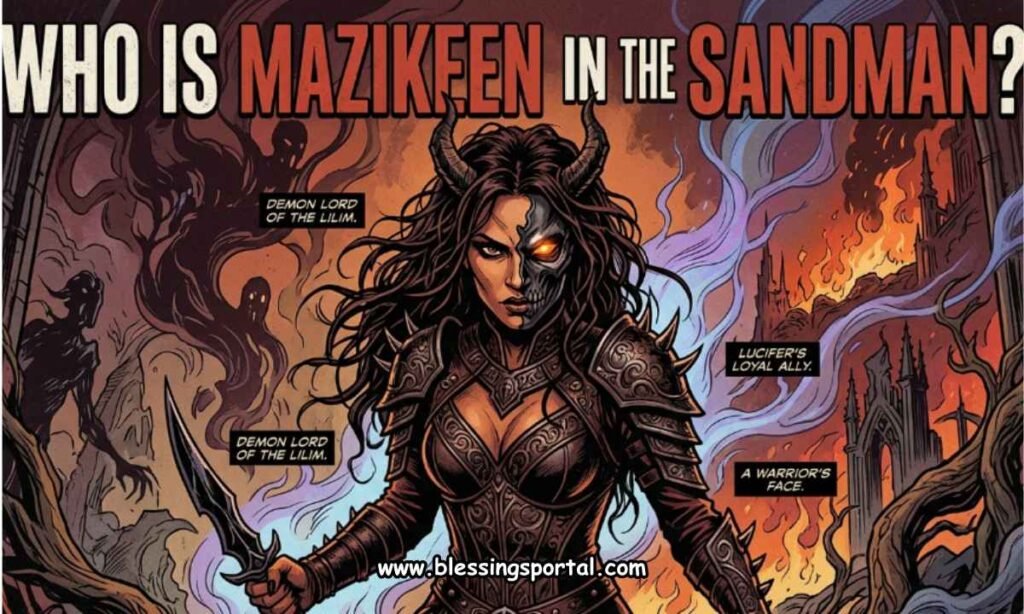
Mazikeen’s first appearance predates the Lucifer comics and TV show entirely. She was introduced by Neil Gaiman in The Sandman, specifically during the “Season of Mists” storyline the arc in which Lucifer, tired of ruling, abandons Hell entirely and hands its key over to Dream, the series’ protagonist.
In this original appearance, Mazikeen is one of several demon lieutenants serving in Lucifer’s court, present among a much larger ensemble cast rather than functioning as a central figure. Even in this smaller role, though, the visual detail that would define her across every later adaptation is already present: half of her face beautiful, the other half monstrous or scarred, set in stark and unsettling contrast. Gaiman’s version of the character is sharp-tongued and memorable within her limited page time, but she remains a supporting figure in a sprawling story about Dream, Hell, and the fallout of Lucifer’s abdication not a protagonist in her own right.
Mazikeen in Lucifer vs. The Sandman: Key Differences Explained
The gap between Mazikeen’s Sandman appearance and her later role is significant, and tracing it helps explain why the character means such different things to different segments of her fanbase.
When writer Mike Carey developed Lucifer into its own ongoing comic series, spun off from The Sandman, Mazikeen’s role expanded considerably. She became a much more consistent presence at Lucifer’s side, no longer just one demon among many but a specific, recurring companion with her own voice and agenda. That expansion continued, and accelerated further, when the character was adapted for the Fox and later Netflix television series Lucifer (2016–2021), played by Lesley-Ann Brandt.
On television, Mazikeen generally called “Maze” by other characters becomes one of the show’s central cast members. She’s Lucifer’s closest companion from his earliest days on Earth, a skilled bounty hunter working alongside the LAPD, and eventually a character with substantial independent arcs involving identity, found family, romantic relationships, and her long, difficult search for a sense of belonging that isn’t defined entirely by her relationship to Lucifer.
A few concrete differences stand out:
- Scope of role: A minor supporting demon in The Sandman versus a main cast member across the entire run of Lucifer.
- Emotional depth: Largely a visual and tonal presence in Gaiman’s work versus a character given extensive, standalone emotional arcs on television.
- Setting: Confined mostly to Hell and its court in The Sandman versus operating primarily on Earth, in Los Angeles, throughout most of the TV series.
- Relationships: Functions mainly as one of Lucifer’s attendants in the earlier work versus developing significant relationships with multiple other characters including friendships, romances, and found-family dynamics in the show.
The television version also softens and complicates her compared to earlier depictions. Rather than remaining a purely fearsome or purely comic figure, the show gives her real emotional stakes: loneliness, ambition, unmet desires, and a long, sometimes painful process of figuring out what she actually wants once loyalty alone stops being enough.
Mazikeen and Lucifer: Father-Daughter Relationship Explained
It’s worth addressing a common misconception directly: Mazikeen is not Lucifer’s biological daughter in any version of the story not in The Sandman, not in the Lucifer comics, and not in the TV series. The “father-daughter” framing that circulates in some online discussions is fan shorthand describing the emotional shape of their bond, not a literal family relationship established by any of the creators.
Loyal Demon
Across both the comics and the show, Mazikeen’s relationship with Lucifer begins from a position of fierce, almost unquestioning loyalty. She serves as his chief lieutenant and bodyguard in Hell, and when he eventually abandons his throne to relocate to Los Angeles, she follows him not out of obligation, but out of a genuine, long-standing devotion that predates the events of the main story. That loyalty forms the foundation everything else about their relationship is built on.
Strong and Independent Woman
What distinguishes the television adaptation is how directly it pushes back against loyalty as her sole defining trait. Across several seasons, Maze increasingly asserts her own wants recognition for her own accomplishments, a sense of purpose beyond serving someone else, romantic relationships of her own choosing, and eventually a life that isn’t structured entirely around Lucifer’s needs. This shift reframes the relationship from something closer to “master and servant” into something more like a long, complicated friendship between two people who genuinely respect each other but no longer accept an unequal dynamic.
Complexities of Existence
Because the show’s mythology establishes that demons like Maze exist without souls, much of her ongoing arc deals with questions that extend well beyond the fantasy premise: what does it mean to want something you were never designed or permitted to want, and can a person or a demon build an authentic identity outside the narrow role they were originally created to fill? Those questions give the relationship with Lucifer a depth that goes past simple loyalty or simple rebellion, landing somewhere more human than either extreme.
Mazikeen Demon Face: Why Does She Look Like a Demon?
What Happened to Mazikeen’s Face?
The half-human, half-monstrous face has been part of Mazikeen’s visual identity since her very first appearance in The Sandman, and it carries through every subsequent version of the character. In the comics, different tellings offer slightly different in-universe explanations sometimes framed as an old injury she has deliberately chosen never to heal, sometimes framed more simply as her natural demon form showing through a more human-passing appearance she normally maintains.
The television series adapts this idea in a more grounded, consistent way. Maze’s scarred, monstrous face is presented as her genuine, natural form, while her smooth, conventionally attractive human appearance functions more like a mask something lower-ranking demons in the show’s mythology can maintain only with effort and concentration. Strong emotion, exhaustion, or the use of her demonic abilities tend to strip that mask away, letting her real face show through, usually at moments of high tension or vulnerability.
This turns what began as a striking piece of comic-book visual design into a recurring, functional metaphor across the TV series: a character constantly managing how much of her true self she’s willing to let other people see, with her literal face acting as a visible marker of that ongoing negotiation. It’s a detail that rewards attentive viewers, since the moments where her human mask slips are rarely random they tend to line up with the story’s more emotionally exposed beats.
Also Read This: How Old Would Jesus Be Today in 2026? The Real Answer Explained
Mazikeen’s Cultural Impact and Why the Character Resonates
Why She Resonates
A significant part of what made Mazikeen stand out on Lucifer is that the writers resisted keeping her in a purely supporting role. She wasn’t written simply to react to the male lead’s story or to provide comic relief and muscle when the plot required it. Instead, she was given her own arcs, her own romantic relationships, her own friendships independent of Lucifer, and eventually her own reasons separate from anyone else’s story for staying in, or ultimately leaving, the world she’d built for herself on Earth.
Audiences responded strongly to that choice. A demon character working through recognizably human questions about belonging, self-worth, and what it means to want more than the role you were assigned turned out to connect with viewers well beyond the show’s core fantasy premise. Brandt’s performance is frequently singled out by critics and fans alike as one of the show’s most consistently compelling elements, partly because the character was written with enough room to actually grow rather than remaining static across six seasons.
Themes She Embodies
Across her various incarnations from Gaiman’s original supporting demon through Carey’s expanded comic version to the fully realized television character Mazikeen consistently represents a handful of recurring, connected ideas: loyalty that gets genuinely tested rather than simply assumed, the ongoing tension between duty and personal desire, and the particular discomfort of existing between two worlds without being fully accepted by either not entirely welcome in Hell anymore, and never quite fully at home among humans either. That in-between status, more than any single plot point, is probably the core of why the character has kept resonating with audiences well after the show’s finale aired.
Where to Encounter Mazikeen: A Quick Reading and Watching Guide
For readers who want to explore the character beyond a single medium, it helps to know roughly where to start:
- The Sandman (comics), “Season of Mists” arc: Mazikeen’s original appearance, useful for readers interested in her earliest design and her place within Neil Gaiman’s much larger mythology.
- Lucifer (comics) by Mike Carey: The ongoing series that expanded her role significantly beyond the Sandman appearance, giving her a more consistent presence at Lucifer’s side.
- Lucifer (TV series), Fox and later Netflix, 2016–2021: The most widely known version of the character, played by Lesley-Ann Brandt, with the deepest and most extensive individual character arcs across six seasons.
Viewers or readers coming from the show and curious about the comics should expect a noticeably different tone and a smaller role for Maze in the earliest material the character audiences know best from television is very much a product of years of additional development beyond her original comic-book debut.
Frequently Asked Questions
Is Mazikeen a real name in Judaism?
Not as a personal name. “Mazikin” is a genuine folkloric term for a class of spirits in Jewish tradition, but “Mazikeen” as an individual name is a fictional adaptation created for the comics and TV show, not a name used in actual Jewish religious or cultural practice.
Who created the character of Mazikeen?
She first appeared in Neil Gaiman’s The Sandman comics, and was later developed much further by writer Mike Carey in the Lucifer comic series, and again by the creative team behind the Fox and Netflix Lucifer television adaptation.
Is Mazikeen stronger than Lucifer in the show?
No. Within the show’s mythology, Lucifer is a fallen angel with power far beyond that of any demon, Maze included. Maze is an exceptionally skilled fighter, tracker, and bounty hunter, but she isn’t written as being on Lucifer’s level of raw power.
Does Mazikeen appear in every season of Lucifer?
Yes. She’s part of the main cast throughout the show’s entire run, from the first season through the series finale in season six.
Is the term “mazikin” used anywhere else in Jewish tradition besides the Talmud?
Yes. Beyond the Talmud itself, references to mazikin and related folk beliefs appear in later Midrashic literature and in a range of regional Jewish folk customs and protective rituals developed over subsequent centuries.
Does the show ever confirm Mazikeen is related to Lilith?
No. The connection between the two figures is thematic and folkloric rather than a confirmed plot point. Neither the comics nor the television series establishes Mazikeen as Lilith’s daughter or otherwise directly related to her.
Conclusion
What makes Mazikeen worth digging into isn’t just that she’s a well-written character on a popular show it’s how honestly the fiction ends up wearing its source material. Nobody invented a demon out of nothing and bolted on an exotic-sounding name for atmosphere. The writers reached into a genuinely old strand of Jewish folklore, borrowed the shape of an idea that communities have used for well over a thousand years to talk about the unseen and the unexplainable, and then built a specific, evolving character on top of it one with her own face, her own voice, and eventually her own reasons for everything she does.
Also Read This: 140+ Biblical Characteristics of a Good Husband (With Meaning & Bible Verses)

With 4 years of experience writing about blessings and positive living, William Parker is passionate about creating heartfelt content that inspires faith and gratitude. Their mission is to provide readers with daily blessings and uplifting words that brighten lives and nurture inner peace.
2 thoughts on “Who Is Mazikeen? Biblical Origins, Jewish Folklore, Mythology & Lucifer Explained”